Dear all,
Markets in May were characterized by a clear divergence between equities and bonds, with technology once again breaking to the upside. Among global equity markets, Taiwan, South Korea, and the Philadelphia Semiconductor Index, all backed by AI hardware supply chains, led gains with increases of 13.7%, 24.7%, and 19.9%, respectively. Oil prices climbed sharply in the middle of the month before retreating as pressure from US-Iran negotiations eased, triggering equally significant volatility in Treasury yields. In foreign exchange markets, the Dollar Index rose 1.2%, leading most other currencies to weaken broadly. Overall, May was marked by record highs in equities, while bonds and oil pulled back and gold traded in a volatile range.
Looking ahead to June, I expect the market’s largest variable to shift away from geopolitics and toward the Federal Reserve’s leadership transition. We maintain the core view we have held since the beginning of this year: equities over bonds. At the same time, we highlight three key areas of focus as Warsh takes the helm.
I. Warsh Takes the Stage: Three Key Areas to Watch in His Debut
With Warsh officially assuming leadership of the Federal Reserve, the June 18 meeting is likely to become a major “expectation reset” event for markets. Below are the three issues I believe deserve close attention at the June meeting.
First, the dot plot is likely to shift this year’s outlook toward “no rate cuts,” with even the possibility of rate hike projections emerging. Recently, traditionally dovish Fed Governor Christopher Waller showed a noticeable shift in tone during his May 22 speech, stating that US inflation is not moving in the right direction and supporting the removal of easing bias language. Structurally, only three committee members would need to revise their projections upward at the June meeting for the dot plot to move into a “no cuts” stance for this year, making such an outcome highly plausible. In addition, I believe markets should pay close attention to the distribution of the projections. If more than three members project rate hikes, markets will likely begin repricing the Federal Reserve’s policy path.
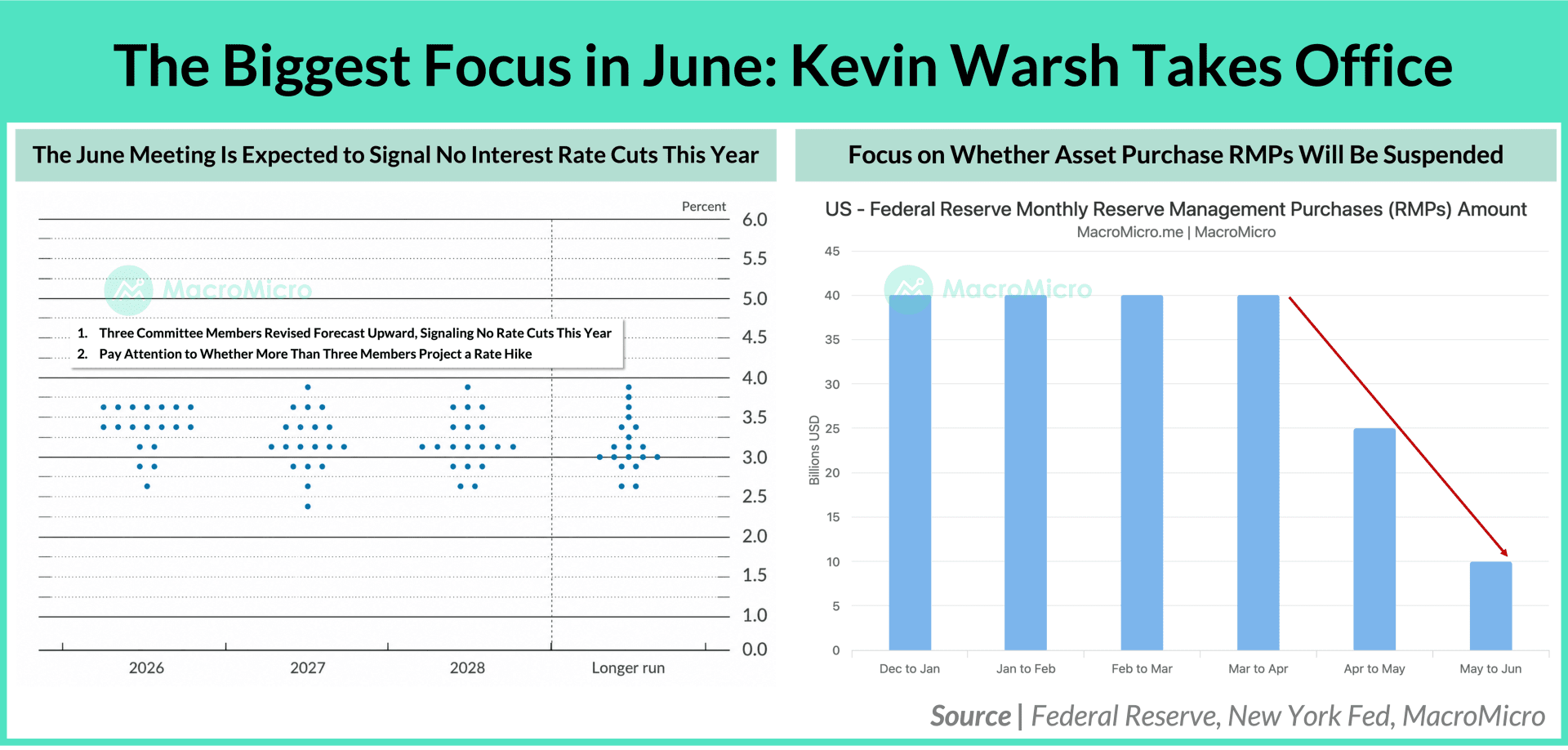
Second, whether the RMPs Treasury purchase program is suspended will directly affect the liquidity gap. Since December of last year, the Federal Reserve has continuously injected liquidity through purchases of short-dated Treasuries under the RMPs program. However, recent purchase volumes have steadily declined from a peak of $0 billion per month, to $25 billion, and most recently to only $10 billion announced for May and June. At the same time, the Treasury Department announced that Q3 debt issuance will increase further to $671 billion, up from $189 billion in Q2, while also raising the target balance of the Treasury General Account (TGA) to $950 billion from $900 billion in Q2. With reserve balances currently hovering near the critical $3 trillion threshold and the TGA balance still below $800 billion, a decision by Warsh not to continue bond purchases, given his historically cautious stance toward such programs, would likely...
This in-depth analysis of the Fed’s policy transition under Warsh, shifting liquidity dynamics, AI-driven earnings resilience, and the growing divergence between equities and bonds is exclusive to MM Max subscribers. Gain full access to the complete report, detailed macro and liquidity analysis, our latest views on Fed policy risks, and continued coverage of global markets, AI supply chains, and cross-asset strategy.
Starting this July, MacroMicro will also evolve into The AI-Native Macro Terminal, featuring the upcoming Global Macro AI Research Assistant and Dynamic Investment Command Center, combining institutional-quality macro, industry, and company data with AI-powered investment workflows. MM Max annual members will be upgraded to Max AI at no additional cost. Subscribe Now» | Step into the AI-Native Macro Terminal Early»

Already a subscriber? Click here to log in.
Full Access to Our Services

Comprehensive data at your service
with key indicators for investment insights

Exclusive flash reports
on key events and data

Create your own charts and analysis
including performance backtesting

Hub of professionals to engage
in meaningful discussions and insights
 Get answers from MM AI.
-
What is the primary market variable expected to influence June, according to MacroMicro?
💡MacroMicro expects the primary market variable influencing June to shift from geopolitics to the Federal Reserve’s leadership transition under Warsh. This transition is anticipated to be a major "expectation reset" event for markets, particularly with the June 18 meeting. The focus will be on potential shifts in the dot plot towards "no rate cuts" or even rate hike projections, decisions regarding the RMPs Treasury purchase program and its impact on liquidity, and the potential for weaker forward guidance, all of which could significantly increase market volatility.
-
How might the Federal Reserve's dot plot shift in June concerning 2024 rate cut projections?
💡The Federal Reserve's dot plot in June is highly likely to shift its 2024 outlook toward "no rate cuts," and there is even a possibility of rate hike projections emerging. This outcome becomes plausible if only three committee members revise their projections upward. Governor Christopher Waller's recent shift in tone, expressing concerns about US inflation not moving in the right direction, further supports this expectation. Additionally, markets should monitor the distribution of these projections closely; if more than three members project rate hikes, it would signal a significant repricing of the Federal Reserve’s policy path, impacting market expectations.
-
How could Warsh's stance on RMPs Treasury purchases impact market liquidity in Q3?
💡Warsh's decision not to continue RMPs Treasury bond purchases, given his historically cautious stance on such programs, would likely lead to liquidity pressures gradually emerging beginning in Q3. This impact is exacerbated by recent trends: RMPs purchase volumes have significantly declined from a peak of $70 billion to $10 billion for May and June. Concurrently, the Treasury Department announced a substantial increase in Q3 debt issuance to $671 billion (from $189 billion in Q2) and a higher Treasury General Account (TGA) target balance of $950 billion. These factors combine to suggest a tighter liquidity environment if purchases are suspended.
-
What is the third crucial risk stemming from Warsh's potential weakening of forward guidance?
💡The third crucial risk stemming from Warsh's potential weakening of forward guidance is a structural increase in market volatility. Warsh has publicly criticized forward guidance, arguing for reduced reliance on it due to limited value. If the Federal Reserve diminishes its use of forward guidance, markets could lose a crucial anchor for rate expectations, resulting in heightened asset volatility. This risk is hard to quantify but potentially far-reaching, necessitating close monitoring of Warsh's communication style, meeting minutes' emphasis on guidance, and the dot plot for unusual omissions at the June meeting.
-
How could weaker Federal Reserve forward guidance structurally increase market volatility?
💡Weaker Federal Reserve forward guidance could structurally increase market volatility by removing a clear anchor for rate expectations. Warsh has openly criticized forward guidance, advocating for reduced reliance on it, which suggests a potential shift away from providing explicit signals about future policy. If the Fed's communication becomes less precise or direct, market participants may struggle to anticipate monetary policy changes, leading to greater uncertainty, increased repricing events, and ultimately, higher asset volatility across various markets as investors react to a less predictable policy path.
-
Which factors does MacroMicro highlight as supporting a constructive market outlook despite risks?
💡MacroMicro highlights two long-term analytical frameworks that support a constructive market outlook despite ongoing risks: supportive fundamentals and the enduring influence of Trump’s pressure logic. Global earnings expectations continue to be revised higher, driven by the AI wave and strong demand across the technology supply chain. Although equity valuations appear elevated by market capitalization-to-GDP ratios, they are not extreme from a price-to-earnings perspective, with AI-benefiting economies seeing structural upward P/E re-ratings. Furthermore, Trump's incentive to end conflicts due to rising domestic energy pressure means equities maintain a relative advantage over bonds, under both best- and worst-case scenarios for oil prices.
-
How does Trump’s pressure logic influence market dynamics, particularly for equities and bonds?
💡Trump’s pressure logic influences market dynamics by creating stronger incentives for him to bring conflicts to an end, particularly affecting equities and bonds. Recent declines in US crude oil and gasoline inventories suggest rising domestic energy pressure. This dynamic means that under both best-case (quick peace negotiations) and worst-case (oil prices remaining in the $90-100 range) scenarios, equities maintain a relative advantage over bonds. The underlying framework suggests that if oil prices exceed $100 per barrel or Treasury yields approach 4.5%, Trump's stance tends to soften, causing risk assets to ultimately revert to trading on fundamentals.
-
What is MacroMicro's overall market allocation recommendation for June, favoring equities?
💡MacroMicro's overall market allocation recommendation for June is to favor equities over bonds. Despite potential near-term volatility stemming from Warsh's arrival at the Federal Reserve, the firm views this as an opportunity rather than a risk. This stance is supported by continuously improving fundamentals, particularly the broad AI deployment trend across major economies like the US, Taiwan, and South Korea, and the enduring influence of Trump’s policy bottom-line framework, which suggests equities will maintain a relative advantage even under challenging scenarios.
-
Which specific regions and asset classes does MacroMicro recommend for equity investment?
💡MacroMicro recommends equity investment in regions benefiting from the broad AI deployment trend. Specifically, the US, Taiwan, and South Korea are highlighted as economies that continue to benefit significantly from this trend. These regions are experiencing structural upward re-ratings in their Price-to-Earnings (P/E) multiples due to strong demand and earnings expectations driven by AI supply chains. This selective approach targets areas with robust fundamental support and significant growth potential within the current technological landscape, aligning with the overall preference for equities over bonds.
-
What fixed income strategy does MacroMicro suggest, considering Warsh's leadership?
💡MacroMicro suggests a fixed income strategy that avoids non-US markets and favors short-duration Treasuries. This recommendation comes amidst expectations of increased market volatility and uncertainty surrounding Federal Reserve policy under Warsh’s leadership, including potential shifts to a "no rate cuts" stance, suspension of RMPs purchases, and weaker forward guidance. By focusing on short-duration Treasuries, investors can mitigate interest rate risk in a potentially tightening or highly volatile rate environment, while generally avoiding international bond markets where risks might be less transparent or harder to manage.

