Five Key Questions on AI: Private Credit Risks, the “SaaSpocalypse,” and the Path to AI Monetization
What You Should Know
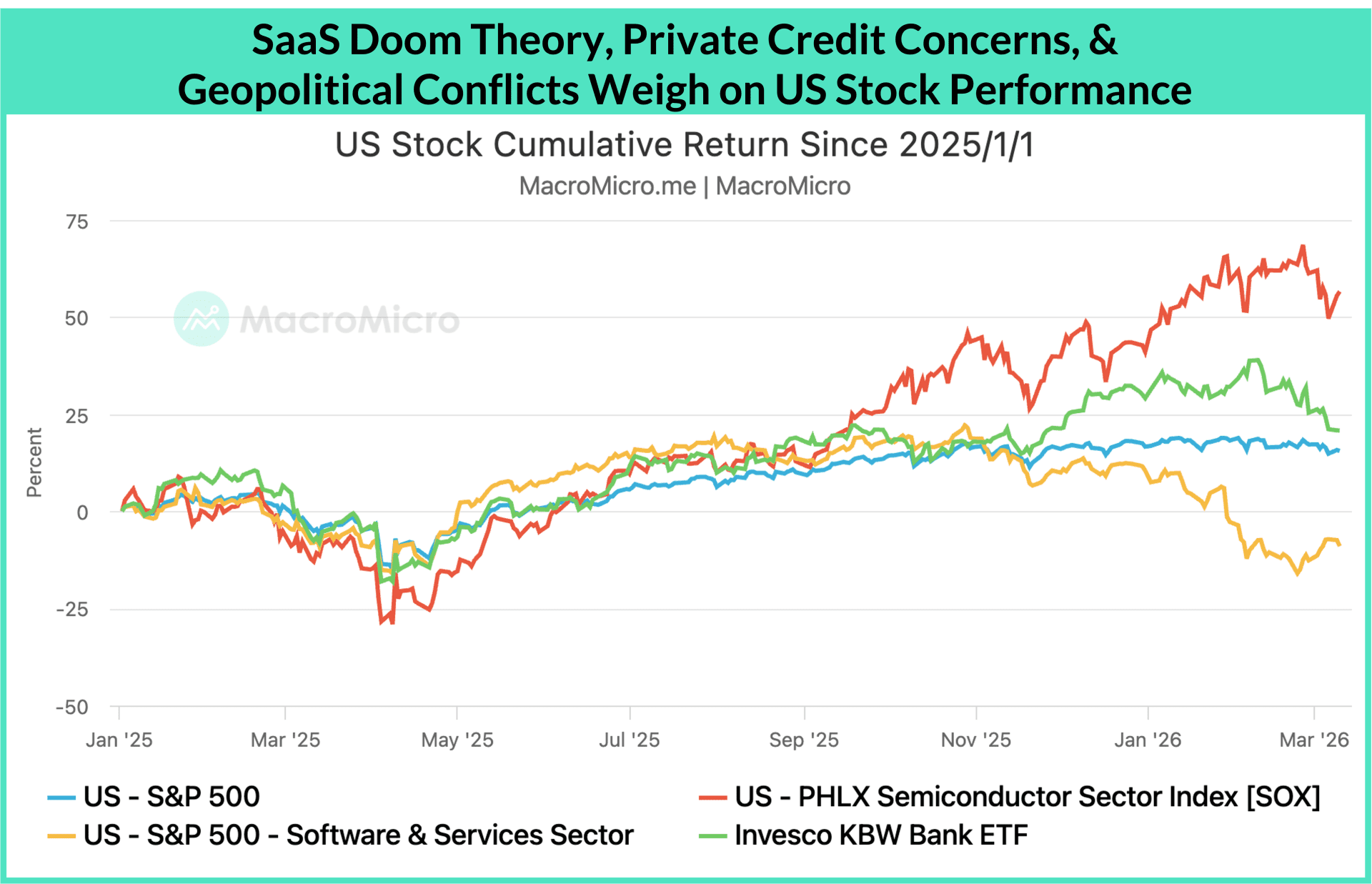
Amid the outbreak of the US–Iran conflict, markets have largely focused on the surge in oil prices and the potential resurgence of inflation, topics we have already examined in several recent articles. In this report, however, we revisit several other concerns currently circulating in the market. Over the past month, multiple incidents related to private credit risk have once again surfaced. At the same time, as AI capabilities continue to advance, investors are increasingly questioning whether software companies could be disrupted by AI. Meanwhile, within the hardware segment, Nvidia’s strong earnings release was followed by a decline in its share price, highlighting the market’s increasingly strict scrutiny of AI valuations.
Against this backdrop of accumulating concerns and the escalating Middle East conflict, the S&P 500 has delivered almost no year-to-date growth as of the March 10 close. Following our previous briefings analyzing the Middle East situation, this report examines five key concerns currently shaping market sentiment, including private credit risks, renewed debate around the “end of SaaS,” and questions surrounding AI monetization.
Key Takeaways:
- Q1: Does hidden risk in private credit increase the probability of systemic financial stress?
- Q2: AI capital expenditure increasingly relies on private credit. What should investors watch?
- Q3: Will AI drive a surge in unemployment and trigger a recession?
- Q4: Is SaaS facing an existential threat? Will AI dismantle its traditional moats?
- Q5: Are there risks emerging within the AI hardware sector as well?
Q1: Hidden Risks in Private Credit — Is Systemic Risk Rising?
Beyond the US–Iran conflict, liquidity risks in the private credit market have recently returned to the spotlight. Following last year’s stress events involving regional banks such as Zions Bancorp and Western Alliance, as well as auto lender Tricolor, turbulence resurfaced in February this year. Asset manager Blue Owl Capital restricted redemptions in its retail debt fund, and on February 27, UK mortgage lender Market Financial Solutions (MFS), which had obtained financing from multiple Wall Street institutions, filed for bankruptcy. Private credit funds managed by large asset managers such as BlackRock and Blackstone have also reportedly experienced record redemption requests, with some funds already hitting their redemption limits.
As risk events continue to emerge from these opaque non-depositary financial institutions (NDFIs), markets have been reminded of a warning issued last year by JPMorgan CEO Jamie Dimon: “When you see one cockroach, there are probably more.” This has renewed concerns that the private credit market may conceal deeper systemic risks. Following the MFS bankruptcy announcement on February 27, the KBW Bank Index fell as much as...
This in-depth analysis of AI-driven private credit risks, the "SaaS doomsday" debate, Nvidia's hardware inventory cycles, and the true timeline for AI monetization is exclusive to MM Max subscribers. Unlock full access to this report, interactive charts, and our ongoing coverage of this fast-evolving tech landscape and market rotation. Subscribe Now»
Already a subscriber? Click here to log in.
Full Access to Our Services

Comprehensive data at your service
with key indicators for investment insights

Exclusive flash reports
on key events and data

Create your own charts and analysis
including performance backtesting

Hub of professionals to engage
in meaningful discussions and insights
 Get answers from MM AI.
-
Does hidden risk in private credit increase the probability of systemic financial stress?
💡No, hidden risks in private credit are unlikely to increase the probability of systemic financial stress because banks' exposure to Non-Depositary Financial Institutions (NDFIs) remains limited. According to S&P Global Market Intelligence data from Q4 2025, most of the top 20 US banks lending to NDFIs have less than 20% of their total assets exposed, with only eight banks exceeding 10%. Additionally, default rates on bank lending to NDFIs have remained low at 0.14%, suggesting current failures are isolated rather than indicative of systemic deterioration.
-
Why is AI capital expenditure increasingly reliant on private credit, and what should investors watch?
💡AI capital expenditure increasingly relies on private credit because large technology companies struggle to fully fund the enormous AI infrastructure costs, and unlisted unicorn companies lack access to public capital markets. Investors should watch for potential funding disruptions if market sentiment shifts and private credit conditions tighten, which could slow corporate expansion and delay profitability. Morgan Stanley estimates private credit could provide over half of the $1.5 trillion in external financing for data center construction by 2028.
-
Will AI adoption drive a surge in unemployment and trigger an economic recession by 2028?
💡No, AI adoption is not expected to drive a surge in unemployment and trigger an economic recession by 2028, largely due to the emerging 'reinstatement effect' of AI. While the 'displacement effect' initially led to 55,000 AI-related layoffs in the US in 2025, the rapid pace of AI penetration, which is three times faster than past technologies, suggests new occupations created by AI Agents will emerge as the technology matures and costs decline. AI is already contributing to per-capita productivity gains, supporting economic growth.
-
Is SaaS facing an existential threat from AI, and will AI dismantle its traditional moats?
💡SaaS companies are indeed facing an existential threat from AI, as AI can automate many white-collar tasks, potentially eroding traditional moats and making annual recurring revenue (ARR) less predictable. However, survival depends on possessing three key moats: a permission moat (access to enterprise-controlled internal data), a data moat (accumulated, domain-specific data assets), and a technology moat (stable, secure, and integrated system maintenance). Companies lacking these moats may face significant risks, while those that adapt will use AI to enhance capabilities.
-
How does the 'reinstatement effect' of AI compare to its 'displacement effect' on the job market?
💡The 'reinstatement effect' of AI creates new tasks and job opportunities, while the 'displacement effect' automates human tasks, reducing labor demand. Currently, the displacement effect is slightly prevailing, evidenced by 55,000 AI-related layoffs in the US in 2025. However, AI's penetration speed is three times faster than past technologies, suggesting the reinstatement effect will soon outpace displacement as AI Agent technology matures and token usage costs decline, leading to new occupations and synchronized growth in productivity and wages, similar to the later stages of the First Industrial Revolution.
-
What are the three key moats that will determine the survival of SaaS companies amid AI advancements?
💡The three key moats determining the survival of SaaS companies amid AI advancements are the Permission Moat (access to enterprise-controlled internal data like customer and financial records, restricted by compliance), the Data Moat (long-accumulated, highly credible, or domain-specific data such as sales negotiations or medical diagnostics), and the Technology Moat (the ability to provide ongoing maintenance, system upkeep, security updates, and integration, which constitutes 50%-80% of software's total lifecycle cost). These moats are crucial for integrating AI with enterprise-specific contexts and deterministic workflows.
-
What is the primary concern for AI hardware in the medium term, and how is it reflected in inventory data?
💡The primary concern for AI hardware in the medium term is over-purchasing, which is reflected in inventory data. Nvidia's Q4 2025 inventory days rose to 108, the highest since Q2 2023, with a shift from raw materials to work-in-process and finished goods. This inventory build-up is largely for pre-shipment stockpiling ahead of massive GB300 deliveries in 1H26. The market will observe if inventory days subsequently fall, indicating demand concerns are subsiding and justifying the continued high revenue growth for AI chip suppliers.
-
How will the shift from seat-based to usage-based models impact SaaS company business?
💡The shift from seat-based (per-head payments) to usage-based (AI workload payments) models will fundamentally transform SaaS company business by moving from selling tools for human use to enabling AI to use tools for assistance. This transition is driven by AI Agents generating significantly higher 'non-human traffic' and operating 24/7, necessitating pricing based on AI workload rather than human users. The future software ecosystem will be built on underlying AI interfaces integrating various SaaS capabilities, deeply interwoven with enterprise data, processes, and systems.
-
How is AI currently demonstrating real value and driving productivity gains across industries?
💡AI is currently demonstrating real value and driving productivity gains across industries through several key indicators. Meta has enhanced Facebook ad click-through rates and Threads usage, while Amazon's AI shopping assistant Rufus has attracted over 300 million users, boosting purchase intent. Anthropic's revenue grew tenfold in one year, and ChatGPT's active users reached new highs despite competition. GitHub code commit volumes have also accelerated, reflecting AI's overall contribution to software development productivity and increasing enterprise willingness to adopt AI solutions.
-
Why is diversified allocation recommended for US stock sectors given current market conditions and AI trends?
💡Diversified allocation is recommended for US stock sectors given current market conditions and AI trends due to elevated market levels, intensified volatility, and geopolitical conflict fluctuations, which lead to frequent sector rotations. While 'technology' remains a core allocation due to clear AI trends, other sectors should be divided into offensive (benefiting when risk appetite rises) and defensive (showing resilience when fear rises) configurations. This strategy allows investors to adapt to changing market sentiment and optimize returns across the 11 major US stock sectors, most of which are projected to grow this year.

