Download the Full Report for Free
Trump’s Tariff Strategy Update
Dear all,
Since Trump announced his reciprocal tariffs on April 2, MacroMicro promptly published a 30+ page deep-dive report analyzing the likely scenarios. In that report, we pointed out three contradictions that undermine the US position, leading us to conclude that the tariff stance would likely soften—a view we’ve since updated in subsequent reports.
Now in July, we’ve compiled this slide-based briefing to offer you the latest insights.
On July 7, Trump unveiled a new tariff list and simultaneously extended the negotiation deadline to August 1—exactly in line with our July CEO House View projection that the US would “adjust tariff intensity + extend negotiation timelines.” This reinforces our view that high tariffs are proving to be self-damaging to the US economy, and that Trump still sees negotiations as his core strategic tool.
In this briefing, we start from the latest developments in negotiations and unpack Trump’s demands and bargaining logic across three dimensions: country-level tariffs, industry-specific tariffs, and non-tariff agreements.
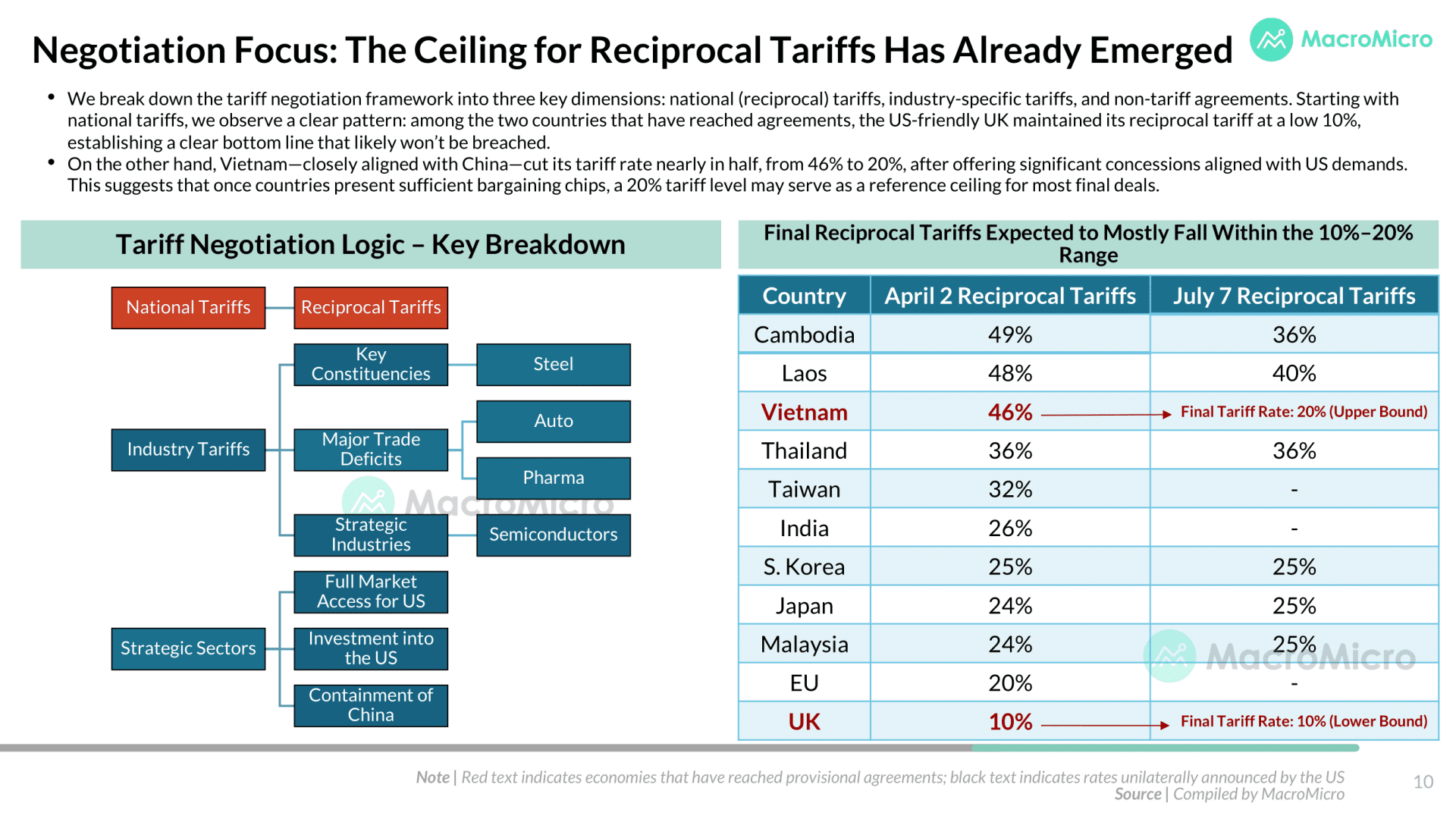
- First, on country-level tariffs, we can observe from two countries that have already finalized trade agreements with the US—the UK (a pro-US ally) and Vietnam (a China-friendly country)—that subsequent tariffs are likely to fall within the 10–20% range. As outlined in our April 2 report, this aligns with our projected scenario of an effective tariff rate increase of 10–15%.
- Second, industry-specific tariffs appear more bark than bite. Most are “conditional tariffs”—steel and aluminum tariffs apply only to their core components; auto parts are exempt if they comply with USMCA rules. The much-anticipated semiconductor tariffs have yet to materialize, largely due to the US semiconductor industry’s dependence on foreign-sourced critical inputs (about 60%). Imposing tariffs in this area would end up harming the US the most.
- Finally, looking beyond tariffs to broader agreements, Trump’s true objectives become even clearer through ongoing bilateral negotiations: market access (e.g., Vietnam reducing import tariffs on US goods to 0%), US-directed investment (e.g., countries placing large orders for Boeing aircraft, US beef, and LNG), and the strategic containment of China.
These demands are repeatedly emphasized in talks with various countries, revealing the core “real agenda” behind Trump’s policy.
In our recent reports, we’ve provided a clear interpretation of what we see as Trump’s “real versus fake” issues. High tariffs, while often front and center in public discourse, are largely a fake issue—a tool rather than a goal. In contrast, foreign investment into the US is a real issue, reflecting a key economic objective. Similarly, the much-hyped concern over US debt default is another fake issue, whereas the Federal Reserve’s interest rate policy, particularly rate cuts, is a real issue with tangible economic implications. Media distractions such as the Mar-a-Lago scandals fall into the fake category, while US dollar hegemony remains a real and strategic priority (for more, see our Q3 MEO).
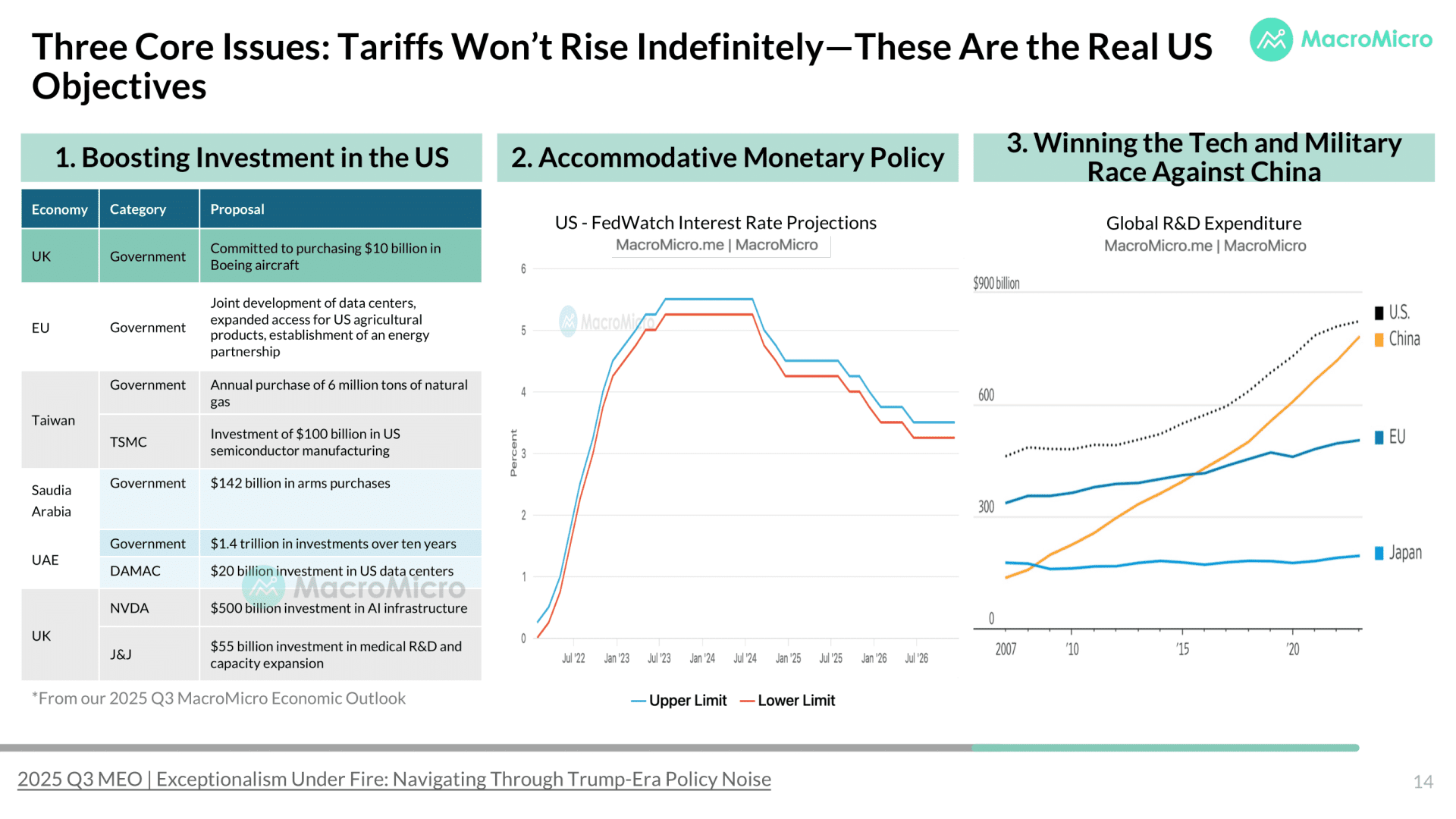
From these observations, Trump’s core policy strategy becomes clear. 1) Domestically, it centers on expanding fiscal stimulus, while 2) internationally, the priority is to maintain sustained pressure on China. Tariffs serve as a crucial instrument within this strategy: they help bridge fiscal gaps created by tax cuts and simultaneously exert leverage on foreign governments. However, it’s critical to note that this strategy is only sustainable under the condition of moderate tariff levels. If tariffs rise too aggressively, they risk driving up inflation, complicating the Federal Reserve’s path to cutting interest rates, exacerbating the US debt burden, and provoking retaliatory actions from trade partners. Once the market internalizes this trade-off, its sensitivity to tariff news will likely diminish.
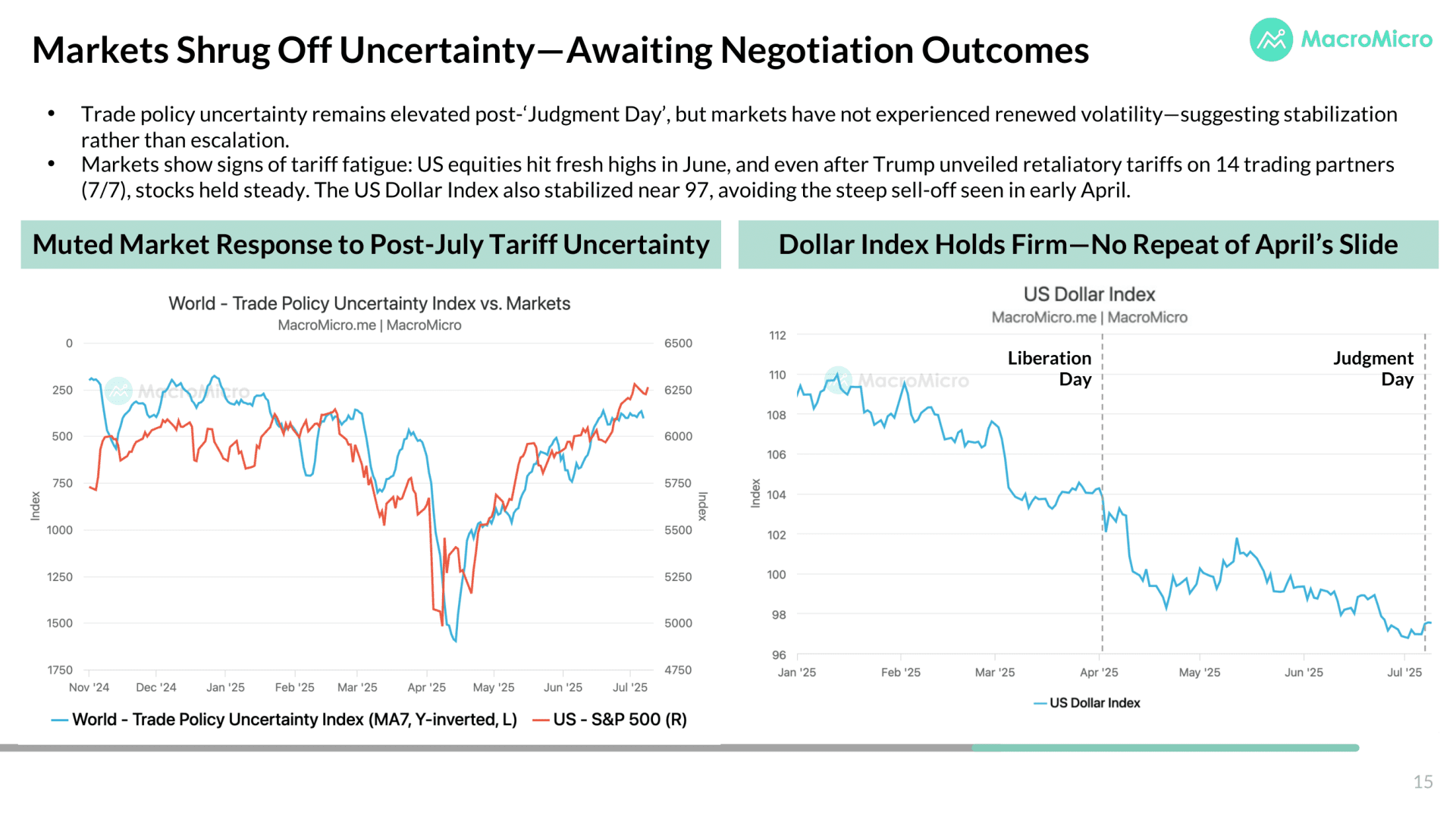
This report also offers a deeper look into the challenges currently facing major US trade partners—Taiwan, the EU, Japan, and China—and outlines potential scenarios going forward. As market sentiment normalizes, we suggest that attention in the second half of the year should return to macro fundamentals: economic growth, inflation trends, and interest rate direction. Regardless of how the tariff situation unfolds, front-loading of imports has already occurred. With economic activity cooling, the key question becomes whether the Federal Reserve can move forward with rate cuts. We continue to expect the Fed to cut rates twice this year, assuming inflation remains within manageable bounds, thereby cushioning downside risks.
The tariff drama is far from over. But in the face of noise, we encourage readers to stay focused: analyze the data, understand Trump’s underlying moves, and continue moving forward with clarity and confidence.

Considering the disruptions caused by Trump's tariffs this year, we’ve made an exception and are offering all members free access to download PDFs. Our goal is to share valuable content and insights with more users during these challenging times.
If you’d like to continue following our analysis on Trump’s policies, feel free to subscribe. You’ll gain access to the latest exclusive reports, as well as unlimited use of the MacroMicro database, research toolbox, and ETF screener. Let us help you regain control over your investments during market turbulence.
