What You Should Know
Recently, markets have been highly focused on bond market reactions. Global bond yields are continuing to surge. Not only has the US 30-year Treasury yield reached 5.13%, hitting a new high since the global financial crisis, but UK and Japanese yields of the same maturity have also peaked at 5.85% and 4.09%, respectively. The former broke a high not seen since 1998, while the latter set a historical record. Equity markets have also turned volatile, undergoing another "valuation adjustment" driven by rising interest rates. What exactly is driving this sharp rise in bond yields? In this article, we break down the key causes behind the recent selloff and conclude with our outlook on global equities and bonds.
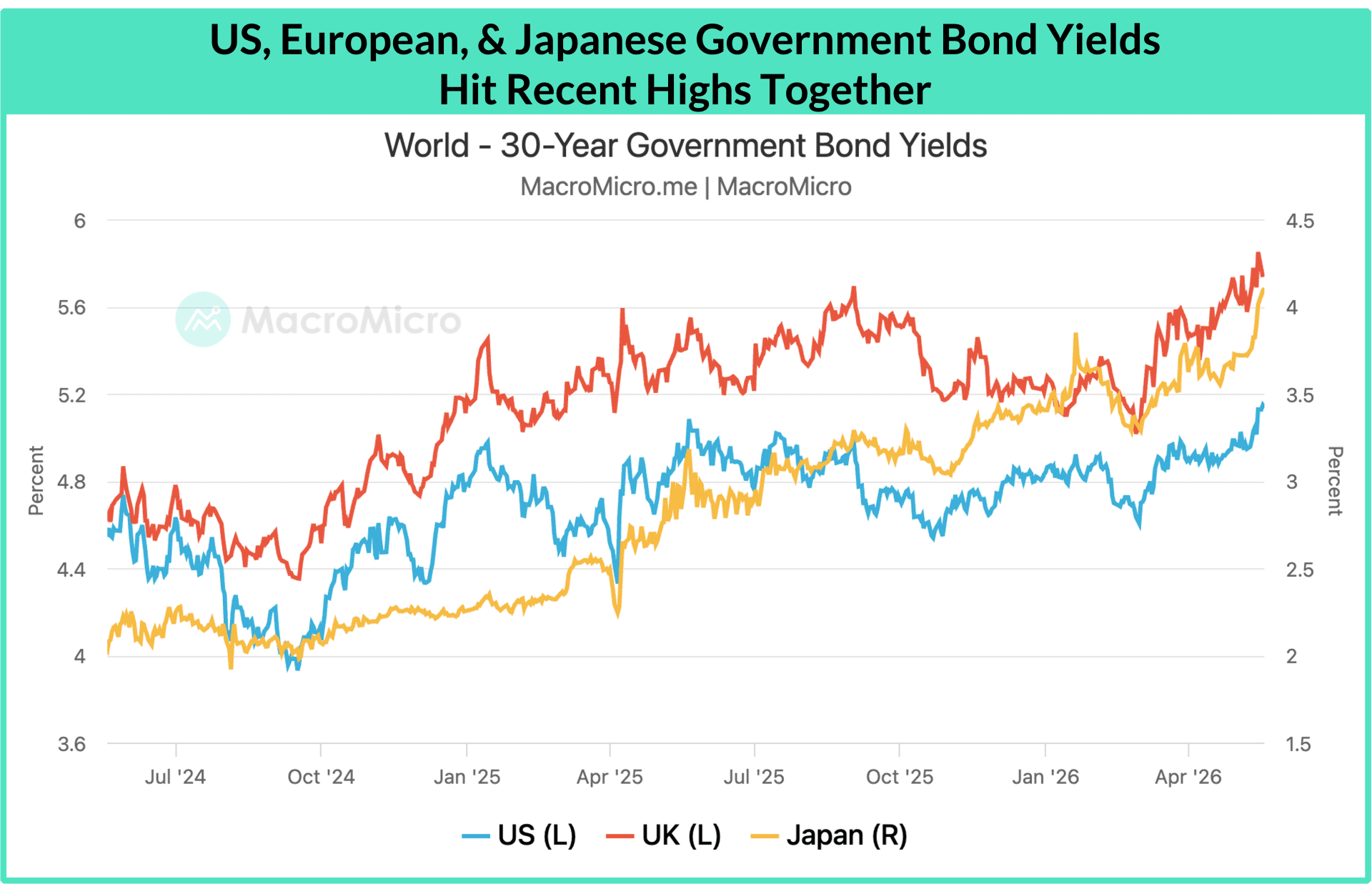
Key Highlights
- The recent rise in global bond yields has been driven primarily by two major developments that reignited market concerns over inflationary pressure from oil prices: first, the lack of meaningful progress on major issues during the Trump-Xi meeting; second, stronger-than-expected US inflation data.
- With US Treasury yields once again returning to critical warning levels, we believe there is a high probability that Trump’s stance will shift toward resolving oil supply bottlenecks as quickly as possible. Beyond watching for changes in Trump’s approach, we also outline three key areas investors should monitor going forward in the bond market.

I. The Core Driver Behind Rising Global Yields: Inflation, Inflation, & More Inflation
On a global scale, the bond market is indeed facing multiple idiosyncratic pressures. These include fiscal uncertainties stemming from changes in UK local elections and potential selling pressure on US Treasuries resulting from Japanese foreign exchange interventions, both of which have exacerbated yield volatility.
However, when we further break down the drivers behind this latest move higher in yields, it becomes clear that the true core issue is not any single country’s debt or political risk. Rather, two recent events have reignited concerns that higher oil prices could fuel inflation once again, strengthening expectations that interest rates will remain elevated for longer and pushing global bond yields higher in tandem.
Event 1: The Trump-Xi Meeting Ended Peacefully, but Lacked Substantive Progress on Major Issues
First, looking at the outcomes of the recent Trump-Xi meeting, the US-China dialogue concluded in a peaceful atmosphere. Both sides released signals of stabilizing relations, expressing an intention to build a "constructive strategic stabilizing relationship." This sets the tone for future US-China relations to move toward "orderly" competition, avoiding a repeat of the fierce, head-on clashes seen in last year's tariff disputes. This is a relatively positive signal.
However, once the details of the negotiations are examined more closely, it becomes apparent that aside from China’s purchasing agreements with the US, the two sides failed to reach meaningful consensus on major issues. Instead, each side emphasized its own priorities. For example, China stressed that the Taiwan issue remained non-negotiable, while the US focused on Iran, maintaining open access through the Strait of Hormuz, and combating drug trafficking.
Among these issues, markets had initially hoped China would play a more active coordinating role regarding Iran and the Strait of Hormuz. However, China’s official statement barely addressed the matter, only indirectly criticizing the US-Iran conflict as “a conflict that should never have occurred and should not continue.” In other words, while the Trump-Xi meeting reduced tail risks of direct US-China confrontation, it failed to eliminate the market’s primary concern...
Is the latest global bond selloff signaling a deeper shift in inflation, oil markets, and interest rate expectations? This report explores the surge in global yields following the Trump-Xi meeting, the inflationary impact of elevated energy prices, Treasury market stress, and why debt sustainability has become increasingly central to the US macro outlook. Unlock full access to this report, proprietary macro data insights, and ongoing market coverage with MM Max.
Starting this July, MacroMicro will also evolve into The AI-Native Macro Terminal, featuring the upcoming Global Macro AI Research Assistant and Dynamic Investment Command Center, combining institutional-quality macro, industry, and company data with AI-powered investment workflows. MM Max annual members will be upgraded to Max AI at no additional cost. Subscribe Now» | Step into the AI-Native Macro Terminal Early»
Already a subscriber? Click here to log in.
Full Access to Our Services

Comprehensive data at your service
with key indicators for investment insights

Exclusive flash reports
on key events and data

Create your own charts and analysis
including performance backtesting

Hub of professionals to engage
in meaningful discussions and insights
 Get answers from MM AI.
-
What key factors caused the recent surge in global bond yields?
💡The recent surge in global bond yields was primarily driven by two major developments: the lack of meaningful progress during the Trump-Xi meeting, which reignited concerns over energy supply risk, and stronger-than-expected US inflation data, particularly from energy-related categories. These events intensified fears that elevated oil prices could fuel persistent inflationary pressure, strengthening expectations for prolonged high interest rates and pushing bond yields higher. The US 30-year Treasury yield reached 5.13%, while UK and Japanese yields of the same maturity peaked at 5.85% and 4.09%, respectively, reflecting these heightened market concerns.
-
Did US inflation data show broad-based price increases or localized energy effects?
💡US inflation data, including CPI and PPI reports, indicated that price increases were primarily localized to energy-related categories and statistical distortions, rather than representing broad-based price increases. Energy prices rose significantly in both CPI (3.8% month-over-month) and PPI (7.8%), contributing over 40% to total CPI inflation. While core services inflation in CPI accelerated to 0.5% and PPI services inflation rose to 1.2%, a deeper analysis revealed that these increases were heavily concentrated in energy-linked sectors such as fuel retailing and transportation, or due to one-off statistical adjustments in rent data from a past government shutdown. Core goods inflation remained subdued at 0.03%, suggesting a contained inflation dynamic driven by energy.
-
What is the primary driver of rising service-related Producer Price Index inflation?
💡The primary driver of rising service-related Producer Price Index (PPI) inflation is its heavy concentration in energy-linked categories and sectors highly sensitive to energy costs. Specifically, fuel and lubricant retailing surged by 26.6% month-over-month, while frontline transportation and logistics services such as truck freight transportation (+8.1%) and air freight transportation (+3.6%) were also significant contributors. In contrast, other service categories excluding trade, transportation, and warehousing rose only 0.1% month-over-month, indicating that the increase in service PPI is largely a transmission of higher oil prices into energy-dependent sectors rather than a broad-based inflationary spread.
-
Why does MacroMicro believe US Treasury yields influence Trump's policy on Iran?
💡MacroMicro believes US Treasury yields influence Trump's policy on Iran because managing debt is a core priority for the US, currently at the peak of its global hegemony. According to Ray Dalio's "The Big Cycle" concept, debt accumulation is a critical risk for a peak hegemonic nation, as its stability underpins the credibility of the US dollar and the US Treasury market. If debt issues, reflected in surging Treasury yields, spiral out of control, it could destabilize the foundation of US hegemony more profoundly than a single geopolitical conflict. Therefore, when the 10-year Treasury yield breaches a critical warning zone, such as 4.4% to 4.6%, it historically prompts a softening of Trump's stance to address economic pressures.
-
How will markets scrutinize service inflation, especially non-housing components, going forward?
💡Markets will scrutinize service inflation, particularly non-housing components, more intensely going forward due to persistently high oil prices. First, next month's rent month-over-month growth rate will be closely watched to confirm if the recent jump was merely a temporary statistical distortion from past missing data during a government shutdown, rather than a true resurgence in rental trends. Second, while markets previously tolerated delayed downward movement in non-housing services inflation (services excluding rent) under expectations of cooling goods prices, the current high-oil-price environment demands that non-housing services inflation at least stop accelerating in the near term. Failure to do so, combined with elevated oil prices, will maintain pressure on bond markets from inflation and interest rate expectations.
-
What is the long-term solution for the US to address its increasing debt pressures?
💡The long-term solution for the US to address its increasing debt pressures is to boost productivity growth. Higher economic growth, driven by improved productivity, will dilute the debt-to-GDP ratio and provide more runway for the sustainability of interest rates. The Trump administration recognizes that domestic debt burdens constrain US global policymaking, making productivity gains crucial. This approach allows for greater tolerance of higher interest rates as GDP growth expands, supporting the sustainability of national finances. AI development is currently the most significant factor expected to contribute to this productivity growth, potentially adding 0.5 to 3.5 percentage points annually.
-
How could AI development potentially impact US productivity growth and interest rate tolerance?
💡AI development could significantly impact US productivity growth and interest rate tolerance by boosting economic output. Major institutions expect AI to contribute between 0.5 to 3.5 percentage points annually to US productivity growth, substantially higher than the 1.5% annualized growth rate observed from 2012 to 2019. If AI successfully drives such an increase, it will lead to higher nominal GDP growth. This higher growth would dilute the debt-to-GDP ratio and provide more fiscal space, naturally increasing markets' tolerance for higher interest rates. The current 10-year Treasury yield warning zone of 4.4% to 4.6% already corresponds roughly to the US nominal GDP growth rate (5% for 2025), and sustained AI-driven productivity gains could further raise this tolerance.
-
Why does MacroMicro predict Trump's stance on the Iran issue will likely soften?
💡MacroMicro predicts Trump's stance on the Iran issue will likely soften due to the surge in US Treasury yields, which reflects increasing debt pressures on the foundations of US global dominance. Given that managing debt is the core priority for a hegemonic nation, and Treasury yields breaching critical warning levels (like 4.6%) indicate significant economic stress, it becomes highly probable that Trump will prioritize a swift resolution to crude oil supply bottlenecks. This shift is motivated by the need to stabilize financial markets and maintain the credibility of the US dollar and Treasury market, which are fundamental to US hegemony, rather than risking a direct conflict that exacerbates debt concerns.
-
What is MacroMicro's outlook on global equities given potential oil supply resolutions?
💡MacroMicro maintains a constructive outlook on global equities, expecting them to outperform bonds, especially if the Strait of Hormuz resumes normal operations. Pullbacks for valuation correction after a strong rebound are considered normal. If oil supply bottlenecks are resolved, market focus will return to fundamentals. Based on Q1 earnings season results, corporate earnings momentum remains strong, which is the primary reason for this positive outlook. This suggests that with reduced geopolitical and inflation risks, equity markets are poised to benefit from robust underlying corporate performance.
-
How do higher term premiums affect long-dated US Treasuries?
💡Higher term premiums affect long-dated US Treasuries by increasing their volatility and limiting the potential for their yields to decline materially. Term premiums are the additional compensation investors demand for holding longer-term bonds compared to rolling over shorter-term bonds. When debt pressures rise, as seen in the current US context, investors demand higher term premiums on long-dated Treasuries, reflecting increased risk. This higher premium makes these bonds more sensitive to market shifts and dampens any potential for their yields to fall significantly, thereby reducing their attractiveness and increasing their price fluctuations.
