Executive Summary:
Recent inflationary developments increase the chance that the FOMC will vote to raise the federal funds rate at this week’s meeting. Today, Ed and Elias examine the hawkish shift and explain why it suggests that a 25bps rate hike this week is more likely than not. … Also: The Fed underestimated the persistence of the 2021-22 inflation shock and won’t be inclined to do so again—lending a hawkish overlay to the Fed’s deliberations. … And: The bond market appears to think a July rate hike is warranted, flagging broader inflationary risks than those represented by energy prices alone. … Check out the accompanying chart collection.
The Fed I: Why a July Rate Hike Is More Likely Now
The June 16-17 FOMC meeting minutes suggests that policymakers see two alternative potential paths ahead. On the dovish path, inflation gradually returns to the Fed’s 2.0% y/y target as price pressures fade, allowing the Fed to keep interest rates unchanged or eventually lower them. On the hawkish path, the labor market remains balanced at full employment while inflation remains troublesome, driven by strong AI-related demand, the Middle East conflict, and tariffs. In that scenario, almost all of the FOMC meeting participants have indicated that additional tightening may be needed to return inflation to the Fed’s 2.0% target.
Following the release of June’s surprisingly low CPI inflation report on July 14, we concluded that a rate hike at this week’s FOMC meeting was less likely than we had thought. However, after the renewed surge in oil prices since then, a rate hike of 25bps at the upcoming meeting now appears to be the likeliest outcome. The oil price surge implies that the Fed’s conditions for additional tightening are falling into place. Consider the following hawkish developments:
(1) Middle East tensions are hawkish. The Middle East conflict has intensified as Iran-backed Houthi rebels attacked Saudi oil tankers in the Red Sea after announcing a maritime blockade of the Bab el-Mandeb Strait. Saudi Arabia responded with strikes on Houthi targets in Yemen, while the United States warned it would hold Iran responsible for further attacks.
The risks to shipping in both straits has raised fears of further disruptions to global energy supplies, recently pushing the Brent crude oil price back above $100 per barrel.
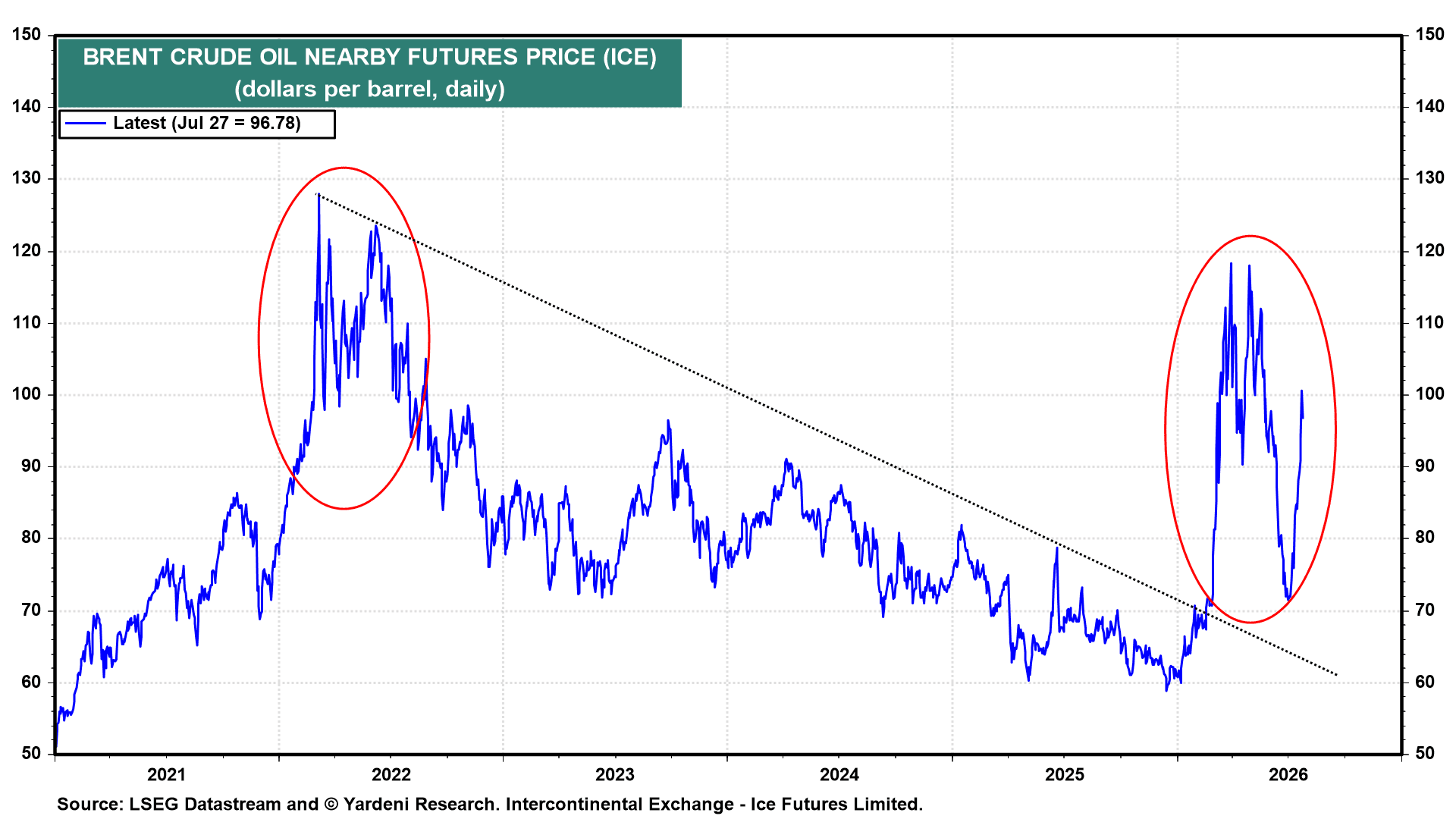 ▌View Related Live Charts: Brent Crude Oil
Gasoline prices have moved firmly back above $4 per gallon, while diesel prices have risen even more sharply and...

