Executive Summary:
This week’s FOMC meeting will be the first over which Kevin Warsh, President Trump’s dovish appointee, presides as Fed chair. Will he succeed in dissuading the hawkishly leaning committee from moving to a tightening bias? Today, Ed and Elias set out both the dovish and hawkish points that the committee no doubt will discuss in what’s bound to be a heated debate. … Also: Warsh steps into his new role planning to implement big changes at the Fed. Elias describes how Warsh views the Fed’s role, the reforms he has in store, and the potential ramifications for Wall Street. … Check out the accompanying chart collection.
The Fed I: The Dovish View
At the FOMC meeting this Tuesday and Wednesday, we expect an intense debate between the committee’s doves and hawks. The hawks will be arguing that the Fed must pivot from April’s easing bias to a tightening bias. The doves will push back. They might concede that an easing bias is no longer warranted, but they will insist that the FOMC should move to a neutral bias, not a tightening one. Let’s review the arguments they are likely to make at their meeting this week, starting with the doves:
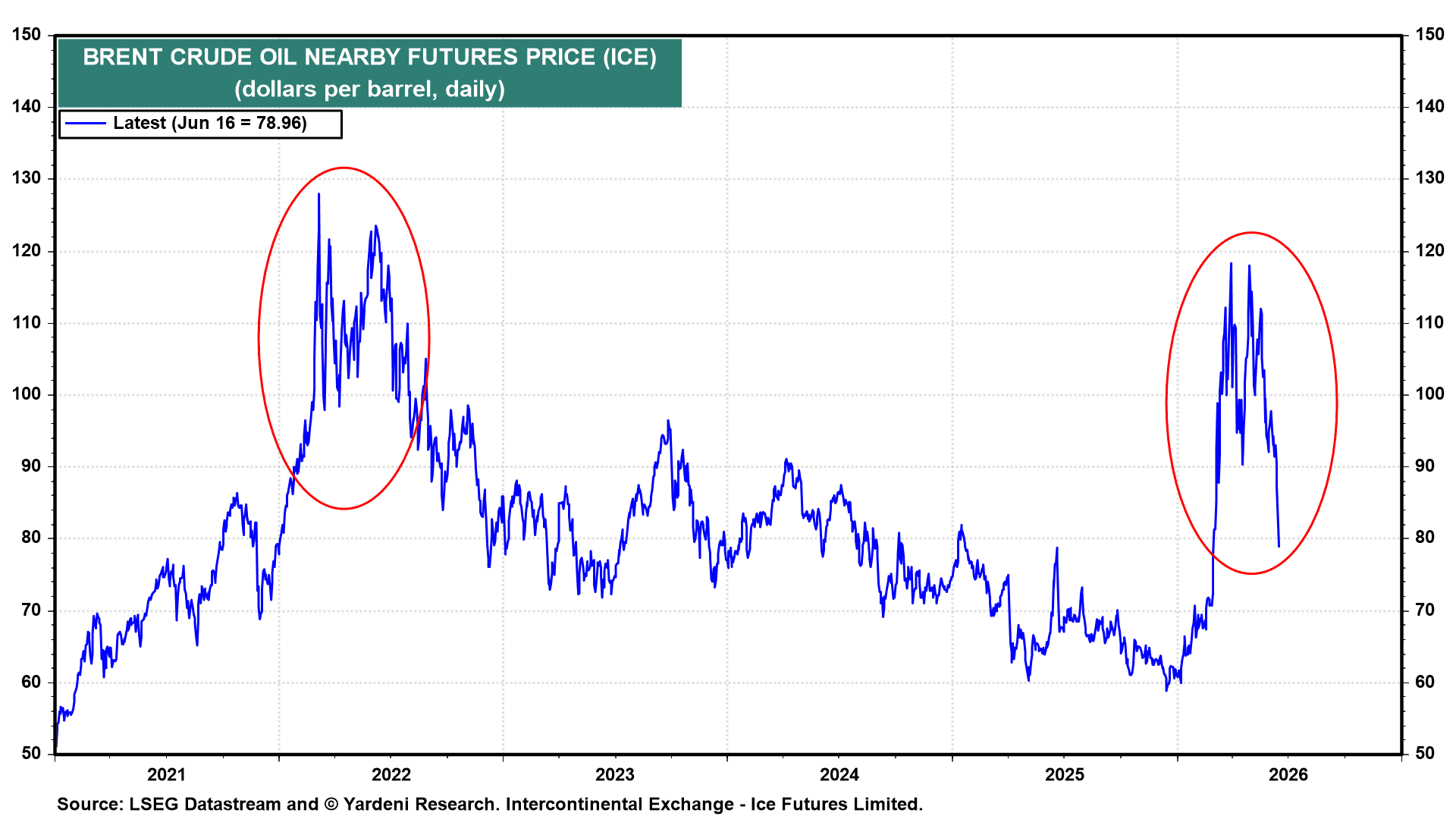 ▌View Related Live Charts: Brent Crude Oil
(1) Dovish: A transitory supply shock. The FOMC’s doves are likely to observe that this year’s inflation surge is completely attributable to the war in the Middle East, which started in March and might end soon. They’ll rightly say that the spike in oil prices was caused by the war-induced closure of the Strait of Hormuz. However, they’ll note that the price of a barrel of Brent crude oil...
 Get answers from MM AI.
-
What is Kevin Warsh's expected impact on the FOMC meeting this week?
💡Kevin Warsh, as the new Fed chair, is expected to preside over his first FOMC meeting this week, advocating for a less hawkish policy stance. His dovish influence will challenge the committee's inclination towards a tightening bias, especially by emphasizing trimmed inflation measures like the Dallas Fed's trimmed mean PCE, which was 2.3% y/y in April compared to the headline PCE at 3.8%. Warsh's arguments will center on the transitory nature of current inflation, primarily attributed to supply shocks, and the lack of a broad inflationary response across the economy, aiming to shift the committee towards a neutral bias rather than a tightening one.
-
What are the dovish arguments regarding the current inflation surge?
💡Doves argue the current inflation surge is a transitory supply shock caused entirely by the war in the Middle East, specifically the closure of the Strait of Hormuz, which led to a spike in oil prices. Brent crude oil, for instance, peaked at $118 on April 29 but has since fallen to $87, and gasoline futures also dropped from $3.76 per gallon on May 18 to $3.05. This suggests that the oil supply shock is temporary and does not necessitate a tightening response from the Fed, especially since there is scant evidence of broad inflationary pressures, with wage inflation remaining subdued.
-
Why do doves believe the Fed cannot resolve supply-side inflation effectively?
💡Doves believe the Fed cannot effectively resolve supply-side inflation because monetary policy is a demand-side tool, not a supply-side tool. Raising interest rates, which affect the economy with long and variable lags, cannot reopen the Strait of Hormuz or address the root cause of supply shocks. Furthermore, supply-shock-driven inflation inherently exerts downward pressure on aggregate demand, meaning a rate hike would unnecessarily amplify negative economic consequences rather than resolving the supply imbalance.
-
Is there evidence of a wage-price spiral or unanchored inflation expectations?
💡There is currently no significant evidence of a wage-price spiral or unanchored long-term inflation expectations, which supports a dovish stance. Unlike 2022, when the labor market was much tighter with demand exceeding supply, generating significant wage inflation, current conditions do not indicate a similar risk. Expected inflation, as measured by the New York Fed, also remains much lower this year compared to the supply-chain disruptions of 2021-2022 and the 2022 oil-price shock, suggesting a persistent increase in underlying inflation is unlikely.
-
How does subdued unit labor cost inflation support a dovish stance?
💡Subdued unit labor cost inflation strongly supports a dovish stance by indicating that broader inflationary pressures are not taking hold. Unit labor cost inflation rose only 0.5% year-over-year in Q1-2026, marking the weakest growth rate since 2019, primarily due to robust productivity growth. Additionally, wage growth continued to cool in May, with the Atlanta Fed’s Wage Growth Tracker decreasing to 3.5% from 3.6% in April, demonstrating a low risk of a persistent increase in underlying inflation.
-
Which inflation measure does Fed Chair Kevin Warsh publicly advocate using?
💡Fed Chair Kevin Warsh publicly advocates using trimmed mean inflation measures, such as the trimmed mean PCE inflation, which removes extreme price increases and decreases to focus on more stable, generalized price changes. Warsh considers traditional metrics like core PCE a "rough swag" and prefers trimmed averages for their ability to strip out tail risks and one-off items. The Dallas Fed's April trimmed mean PCE stood at 2.3% year-over-year, significantly lower than the headline PCE at 3.8% and core PCE at 3.3%.
-
What hawkish argument suggests passive monetary loosening is already occurring?
💡A hawkish argument suggests passive monetary loosening is already occurring because as inflation rises and the policy rate remains steady, the real federal funds rate declines. This narrowing of the gap between the policy rate and the neutral rate (R*) effectively eases financial conditions without any explicit action from the Fed. This passive loosening contributes to the hawkish view that the Fed needs to actively shift towards a tightening bias to counteract this effect and prevent further inflation.
-
How might the AI buildout contribute to future inflationary pressures?
💡The AI buildout could contribute to future inflationary pressures through synchronized global demand for energy, commodities, and specialized labor, which is persistently feeding into input costs. As these costs become embedded in operating structures, firms are expected to pass them on, creating a durable inflationary impulse. Already, consumer prices for computer software & accessories surged 14.5% year-over-year in May 2026, and producer prices for electronic components & accessories rose 26.9%, reversing decades of deflation in these sectors.
-
Why does a tightening labor market raise the risk of a wage-price spiral?
💡A tightening labor market raises the risk of a wage-price spiral because structural constraints on labor supply, such as immigration restrictions and Baby Boomer retirements, persist while labor demand appears to be rebounding. If the gap between labor demand and supply widens further, it can lead to significant wage inflation. This increase in wages can push up unit labor costs, which firms then pass on to consumers through higher prices, thereby fueling a wage-price spiral and persistent underlying inflation.
-
What are the potential ramifications of Warsh's proposed Fed reforms?
💡The potential ramifications of Warsh's proposed Fed reforms include increased market volatility due to a less communicative Fed, as fewer signals and a revised Dot Plot will reduce predictability for investors. Wall Street will need to adjust to an institution focused strictly on its statutory mandate, with a narrower role that avoids political debates. Furthermore, the shrinking of the $6.7 trillion balance sheet, exit from mortgage-backed securities, and adoption of a rules-based rate-setting framework will fundamentally alter the Fed's operational approach, impacting overall financial conditions and market stability.

