Executive Summary:
The June jobs report was widely characterized as weak. Ed and Elias don’t see it that way. The disappointing headline gain reflected a misleading statistical distortion. June’s decline in Leisure & Hospitality was attributable to an early Memorial Day, which boosted May’s gain. With the support of multiple underlying strengths, the labor market remains resilient, as demand slightly exceeds supply. The Fed’s tightening bias—prioritizing its inflation mandate over its labor market one—therefore remains appropriate, with a July rate hike still possible. … Check out the accompanying chart collection.
US Labor Market I: Don’t Judge a Jobs Report by its Headline
he June payroll employment report was described by many as weak. We disagree. A statistical distortion in the report reinforces our constructive view of the US labor market.
The US economy added 57,000 payroll jobs in June, well below the 113,000 consensus and the lowest gain since February.
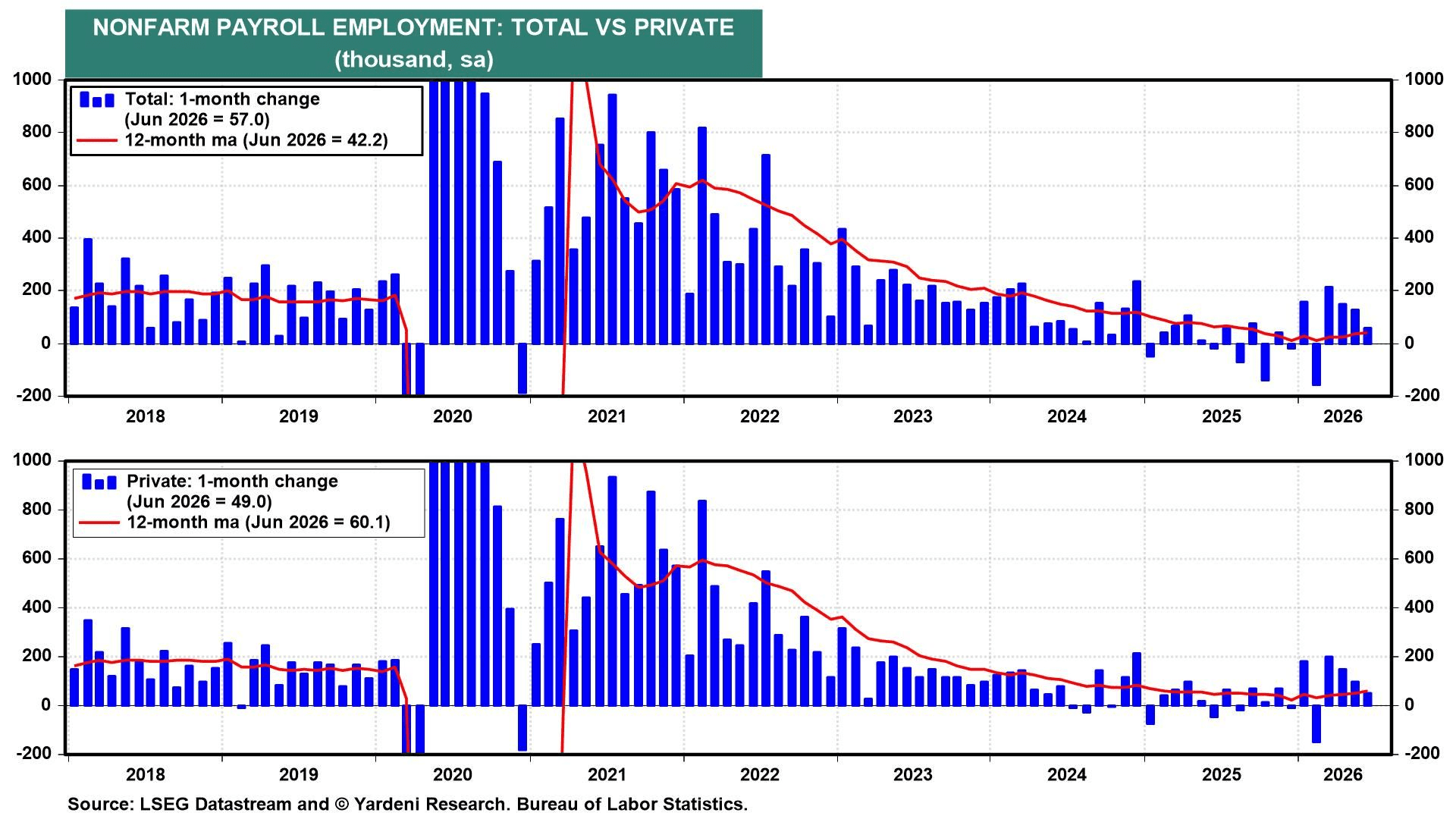 ▌View Related Live Charts: US - Nonfarm Payrolls vs. Unemployment Rate
Payroll growth figures for the prior two months were revised lower by a net 74,000. That seems like a meaningful deceleration in jobs growth, but the three-month moving average, which smooths out monthly volatility, tells...
 Get answers from MM AI.
-
What factors are boosting employment in the Construction and Manufacturing sectors?
💡Employment in Construction and Manufacturing sectors is boosted by the AI infrastructure buildout. Non-residential construction, in particular, is leading the way due to the development of data centers, while manufacturing jobs growth has become broader-based, with more than half of all manufacturing sectors reporting higher payrolls in June. These trends generate demand for physical labor in specialized trade contractors and factory production.
-
Why does the article argue against viewing June's headline jobs number as deterioration?
💡The article argues against viewing June's headline jobs number as a sign of broad deterioration due to several factors: a statistical distortion in Leisure & Hospitality from an early Memorial Day, which actually saw non-seasonally adjusted employment rise to an all-time high; a solid three-month moving average of 111,300 for payroll growth; and the breadth of job creation indicated by diffusion indexes. The three-month-span diffusion index held at 56.2%, and the six-month span diffusion index rose to 54.2%, its highest since early 2025, suggesting more than half of private-sector industries are still reporting higher payrolls.
-
What caused the decline in the US labor force participation rate in June?
💡The decline in the US labor force participation rate to 61.5% in June, the lowest since May 2020 (excluding the pandemic, the lowest since May 1976), was primarily caused by a contraction in labor supply, not a decline in labor demand. This contraction was driven by a significant increase in flows from unemployment to not-in-the-labor-force and from employment to not-in-the-labor-force, particularly concentrated among workers aged 25 to 34, and notably influenced by a substantial, albeit statistically distorted, decline in the foreign-born labor force.
-
How did the flow from unemployment to not-in-the-labor-force change in June?
💡The flow from unemployment to not-in-the-labor-force surged by 226,000 to 1,839,000 in June, reaching its highest level since September 2021. This increase, coupled with 1.9 million individuals unemployed for 27 weeks or more, suggests discouragement among long-term unemployed workers who may have stopped searching for jobs, exacerbated by a structural skills mismatch due to AI adoption, leading them to exit the labor force.
-
What is the likely impact of Baby Boomer retirements on labor supply?
💡Baby Boomer retirements are expected to keep flows from employment to not-in-the-labor-force elevated, weighing on the labor supply for several more years, as Social Security data indicate an accelerating pace of retirements among this aging demographic. While not the primary driver of June's decline in labor force participation, which was concentrated in younger cohorts, the ongoing retirement trend contributes to structural shifts in labor supply.
-
Which age group primarily drove the significant decline in labor force participation in June?
💡The significant decline in labor force participation in June was primarily driven by workers aged 25 to 34, with their employment falling by 643,000 and their labor force level declining by 765,000. This represents the largest monthly decline for this age group outside the pandemic period, suggesting many in this cohort exited the labor force entirely rather than becoming unemployed, accounting for a substantial share of the overall labor force reduction.
-
What role did the foreign-born labor force play in June's labor force decline?
💡The foreign-born labor force played a significant role in June's labor force decline, contracting by 740,000, which was the largest monthly drop on record outside of the pandemic period and largely accounted for the overall decline of 720,000 in the total labor force. This decline, concentrated among 25- to 34-year-olds, is attributed to a combination of tightening immigration policies and a significant statistical distortion in the unadjusted Household Survey data, which is subject to high sampling variability.
-
What does the June jobs report suggest about real incomes in the US economy?
💡The June jobs report suggests real incomes could be improving, as average hourly earnings rose 3.5% year-over-year, and the YRI Earned Income Proxy increased 0.3% month-over-month in May. Critically, the Cleveland Fed Nowcasting tool estimates that headline inflation declined 0.06% month-over-month in June due to falling energy prices, implying that the inflation-adjusted EIP rose approximately 0.4%, which likely led to an increase in real disposable personal income.
-
Why does the Federal Reserve's tightening bias remain appropriate after the June jobs report?
💡The Federal Reserve's tightening bias remains appropriate after the June jobs report because the labor market, while healthy and resilient, is not tightening enough to fuel a wage-price spiral, as evidenced by a scant 0.5% year-over-year increase in unit labor costs in Q1-2026. Given that underlying inflation remains uncomfortably above its 2.0% target and the balance of risks is skewed toward inflation, the Fed's priority remains price stability, making a July rate hike still possible.
-
What are the key drivers for a constructive employment growth outlook?
💡The key drivers for a constructive employment growth outlook include resilient consumer spending, the ongoing AI infrastructure buildout, and broader AI adoption. These factors are expected to support hiring across a range of industries in the near term, contributing to a labor market that is well-balanced and exhibiting more resilient and broad-based job growth than in much of 2025.

