Dear all,
Market performance in January was highly concentrated in gold, rare earths, cryptocurrencies, nuclear energy, defense (drones), and AI (memory)—precisely the three major trends and six beneficiary sectors we have repeatedly emphasized over the past year. Global equity markets broadly reached new highs once again, led by technology-heavy markets and indices. South Korea’s KOSPI, the Philadelphia Semiconductor Index, and the Taiwan Weighted Index rose 22.7%, 17.3%, and 13.3%, respectively.
In contrast, bond markets faced a broad rise in yields and falling prices, reinforcing a clear “equities over bonds” environment. Commodities saw particularly striking gains in gold and silver, up 27% and 65.8%, respectively, driven primarily by de-dollarization trends and heightened geopolitical disruptions. Overall, markets are displaying a dual dynamic: precious metals as a hedge, equities as risk assets—both coexisting simultaneously.
The More Turbulent the Market, the Higher Stocks Climb
“The more chaotic the market, the higher stocks rise” feels almost like a phenomenon unique to January. Since the start of the year, events have seemed relentless, from Trump’s actions targeting Venezuela and European tariffs, to the Greenland issue, and even rhetoric around taxing DRAM. Yet on closer inspection, it becomes clear that Trump’s actions are no longer directly aimed at China, or more precisely, that it has become increasingly difficult to do so.
As we noted in last month's Houseview, under a “US–China 2.0” framework, China’s economic resilience and policy leverage are fundamentally different from the past. As a result, US–China relations are likely to enter a relatively calmer phase in 2026, reducing their direct impact on the economy and markets and allowing risk appetite to persist.
That said, the events mentioned above, whether the Greenland issue (with the US focused on rare earth supply chain positioning) or the arrest of Venezuela’s president (aimed at preventing excessive alignment between China and Venezuela), clearly show that US–China strategic rivalry has not disappeared. Instead, it has shifted to a longer-term battlefield. While short-term equity market reactions remain muted, underlying competition continues to intensify. This dynamic reinforces the relevance of the “three strategic arenas” and “six beneficiary sectors” we have consistently highlighted as the key market drivers: Productivity (AI, nuclear energy/power), Hegemony (defense, rare earths), and Currency (gold, stablecoins).
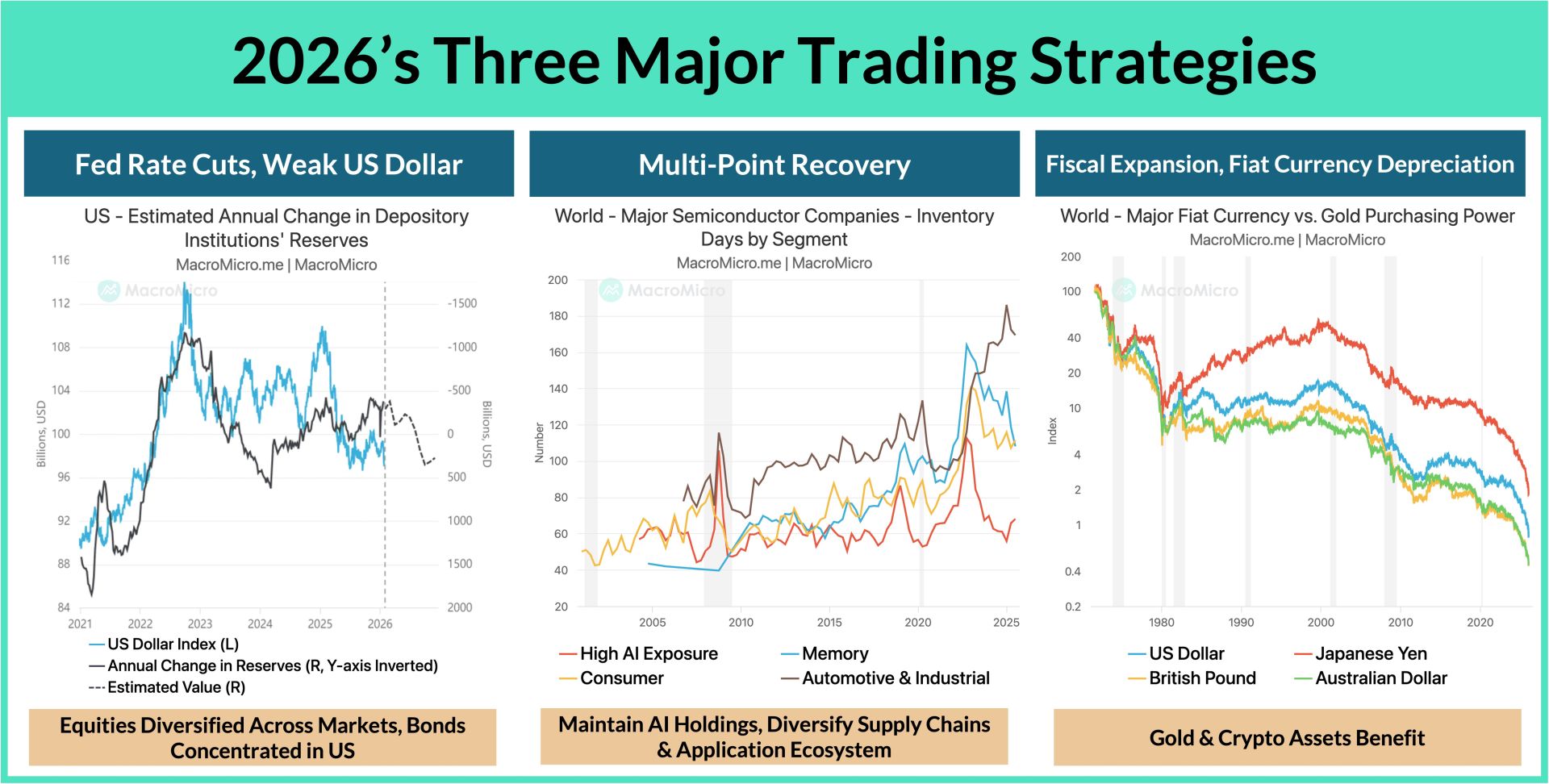
II. Fundamentals Remain Intact, Multi-Point Recovery Continues to Gain Traction
Beyond the factors above, there is one crucial reason the rally has persisted: fundamentals have not been damaged. I will illustrate this using TSMC’s earnings call and current economic expectations.
On the day of TSMC’s earnings call, I focused on two key indicators. First, the company’s...
This article is exclusive to subscribers. If you're not a subscriber yet, subscribe to MM Max today and gain full access to all our charts, reports, including our full 2026 MacroMicro Economic Outlook, and more. Subscribe Now»

Already a subscriber? Click here to log in.
Full Access to Our Services

Comprehensive data at your service
with key indicators for investment insights

Exclusive flash reports
on key events and data

Create your own charts and analysis
including performance backtesting

Hub of professionals to engage
in meaningful discussions and insights
