CEO House View | Three Pillars Bearing 2026's Markets: The Political, Monetary, and Fundamental Dynamics Ahead
Dear all,
Time flies—how has this year treated you so far? As we step into a new year, we’d first like to wish you a very happy New Year. In this monthly outlook, the MacroMicro research team looks ahead to 2026, helping you get an early grasp on the key market themes that will shape the year ahead.
In 2025, global markets began amid panic over Trump-era tariffs, yet ended the year with an unusual outcome: equities, bonds, and gold all rising together. Looking back, the market’s turning points were largely driven by two critical moments.
The first came on April 2, when reciprocal tariffs were officially announced, triggering sharp market volatility. The MacroMicro research team immediately released a 30+ page in-depth tariff report, and consistently emphasized in subsequent analysis that April 2 would mark the peak of tariff-related downside risk—with the impact expected to fade gradually thereafter. As anticipated, markets bottomed in April and trended upward from that point on.
The second key moment arrived in July, when Trump formally confirmed a delay in tariff implementation. MacroMicro promptly adjusted its research focus toward medium- to long-term investment trends and opportunities under the “Trump 2.0” policy framework, identifying three major strategic arenas of competition:
- Productivity (AI, nuclear energy/power infrastructure)
- Hegemony (defense, rare earths)
- Currency (gold, stablecoins)
From these themes, we further derived the industries most likely to benefit.
Global equity markets posted gains exceeding 15% in 2025. In fixed income, both high-yield bonds and government bonds recorded broad-based advances. Among commodities, gold remained the top performer, while the dollar was the sole underperformer, supported only by liquidity provided by the Federal Reserve.
Having navigated 2025 successfully, we now turn our attention to 2026. Below, we outline three major trends to watch—across politics, liquidity, and fundamentals.
Trend 1: Politics — US–China Relations Enter a Cooling-Off Phase, Geopolitical Risks Likely to Ease
Have you noticed that China has become a tougher opponent in this second round of US-China tensions? I believe there are two key reasons.
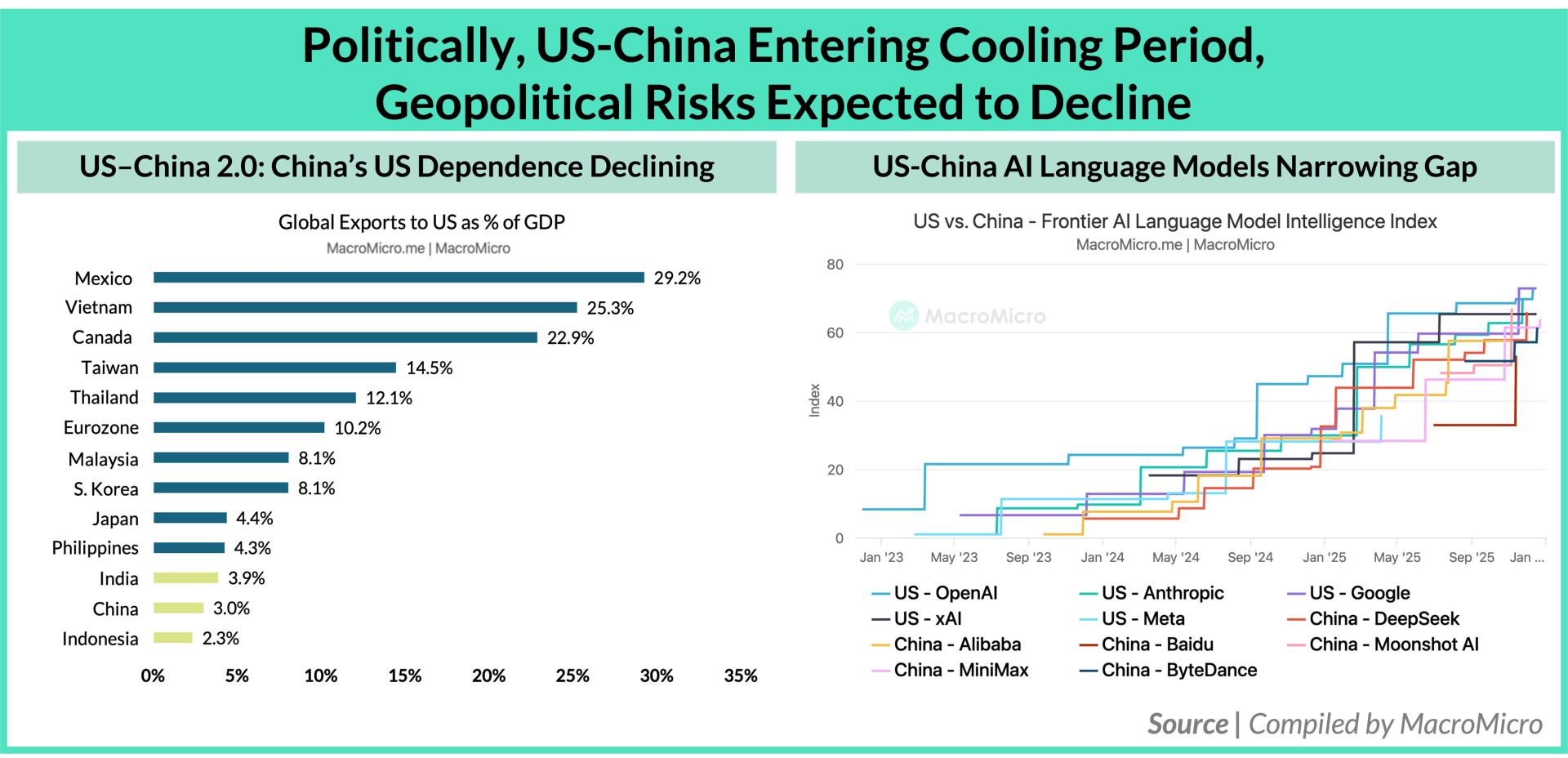
On the trade front, China began reducing its US dependence well before Trump took office. Exports to the US have fallen from 20% two years ago to just 10%, accounting for only around 3% of GDP. With this buffer in place, China’s response to the US imposing 100%–140% tariffs this year was markedly different from the first round of trade tensions. Instead of backing down, China retaliated forcefully—signaling that it would rather absorb a 3% GDP hit than risk undermining domestic confidence.
On the technology front, we have repeatedly highlighted that while the US...
This article is exclusive to subscribers. If you're not a subscriber yet, subscribe to MM Max today and gain full access to all our charts, reports, including our full 2026 Macro Outlook Series, and more. Subscribe Now»

Already a subscriber? Click here to log in.
Full Access to Our Services

Comprehensive data at your service
with key indicators for investment insights

Exclusive flash reports
on key events and data

Create your own charts and analysis
including performance backtesting

Hub of professionals to engage
in meaningful discussions and insights
