What You Should Know
For the ETF market, 2025 was unquestionably another year for the history books. Global ETF assets under management (AUM) surged from USD 15 trillion to USD 19 trillion. The US ETF market, riding a renewed “Trump effect,” continued to dominate with roughly 70% global market share, demonstrating absolute leadership, and sweeping a rare “triple crown” as issuance volume, trading volume, and net inflows all reached record highs.
The Asia-Pacific region was no less impressive, as passive investing gained momentum across markets. China’s ETF market surpassed RMB 6 trillion, overtaking Japan to become Asia’s largest, supported by aggressive government market stabilization, accelerated regulatory approvals (such as the CSI A500), and a decisive shift by investors toward passive strategies.
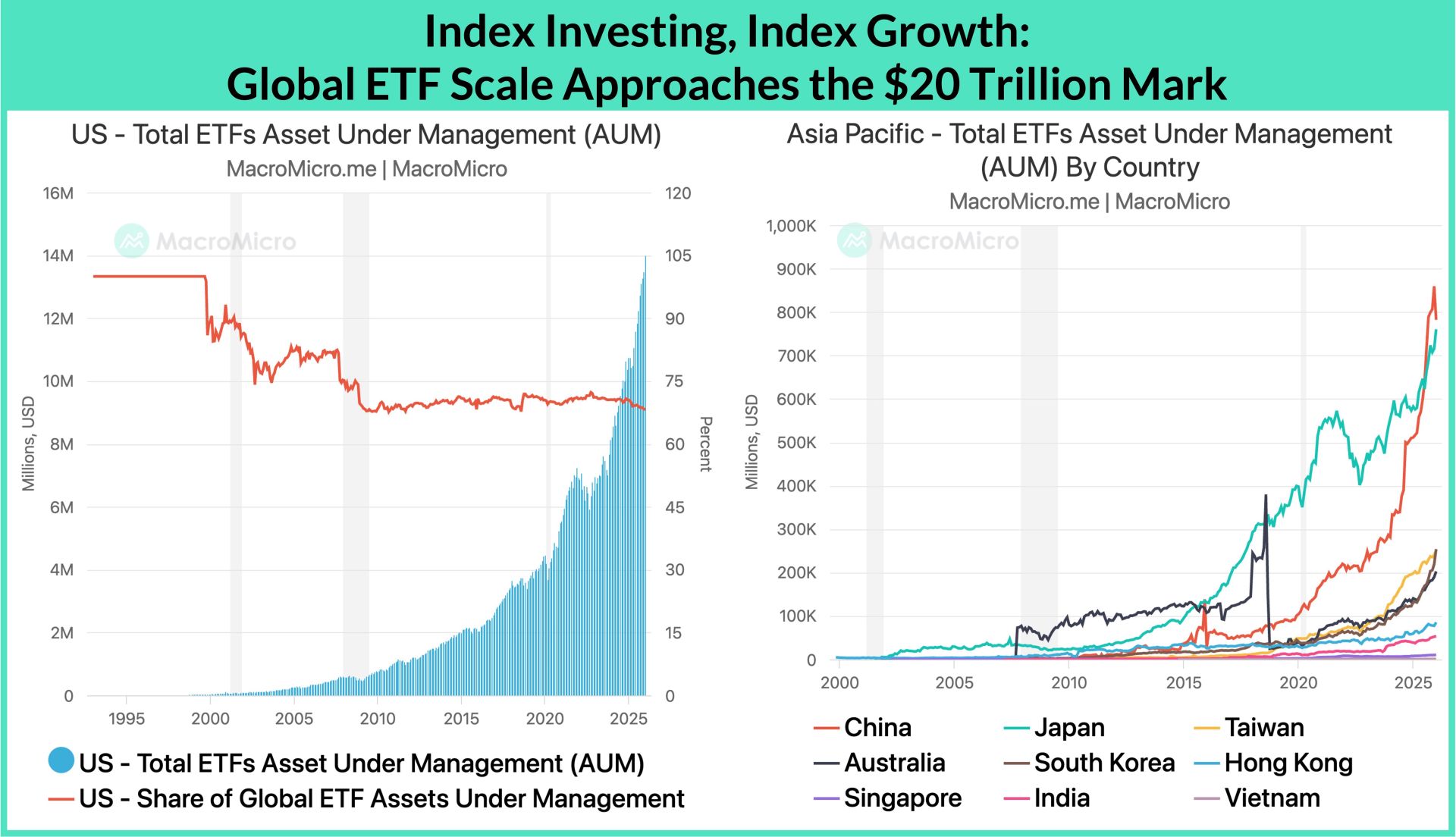
Since the launch of the first ETF more than three decades ago, the industry’s steady “encroachment” has fundamentally reshaped global investing. Bloomberg projects global ETF AUM will reach USD 35 trillion by 2035 (CAGR ~10%). Given that market growth approached 30% last year—with roughly 40% driven by strong net inflows—this forecast may even prove conservative. Passive and index investing have clearly entered a golden era.
At MacroMicro, we often emphasize that a company’s fundamentals lie in its financial statements, but the fundamentals of index ETFs are rooted in macroeconomics. That is precisely why ETF analysis matters. Looking ahead to 2026, we distill our views into five key Q&As, spanning equity-bond core allocation, product structure evolution, the second half of the AI race, geopolitics, the rise of alternative assets, and entirely new investment frontiers, showing how investors can use ETFs to invest globally and position for long-term trends.
Key Takeaways:
- US Exceptionalism vs. Global Rebalancing: Do Us equities and Treasuries remain dominant, or will global capital rotate?
- Extreme Tech Concentration: Do ETFs still offer diversification value? Which ETFs benefit most from the AI race?
- Geopolitics & US-China Rivalry: Do defense and critical minerals ETFs remain the main battlefield?
- Currency Competition Intensifies: Gold, silver, and crypto, and how ETFs tie it all together.
Q1: US Exceptionalism vs. Global Rebalancing — Will US Assets Stay Dominant?
From an asset allocation perspective, we continue to favor US stocks as the "core holding" in portfolios, primarily due to the strong earnings power of AI-driven tech stocks (2026 expected EPS YoY +40%), which also drove S&P 500 EPS YoY to +18% this year (up from 12.8%). Combined with stable US GDP growth projected at 2% in 2026 (see our US Outlook), and dual fiscal-monetary easing, the US economy retains resilience. Of course, amid concerns over high valuations, debt accumulation, and K-shaped divergence, we believe...
This article is exclusive to subscribers. If you're not a subscriber yet, subscribe to MM Max today and gain full access to all our charts, reports, and more. Subscribe Now»

Already a subscriber? Click here to log in.
Full Access to Our Services

Comprehensive data at your service
with key indicators for investment insights

Exclusive flash reports
on key events and data

Create your own charts and analysis
including performance backtesting

Hub of professionals to engage
in meaningful discussions and insights
 Get answers from MM AI.
-
Which ETFs should investors consider for US equity core holdings in 2026?
💡Investors should continue to favor US stocks as the "core holding" in portfolios for 2026, primarily due to the strong earnings power of AI-driven tech stocks, which are projected to have an expected EPS YoY growth of +40%. This also drove the S&P 500 EPS YoY to +18% in 2025, up from 12.8%. Coupled with stable US GDP growth projected at 2% in 2026 and dual fiscal-monetary easing, the US economy demonstrates resilience. ETFs such as VOO and IVV are recommended for long-term accumulation due to their low fees and efficiency, offering a robust way to capture broad market performance while benefiting from the core strength of US equities.
-
How can investors diversify beyond US tech stocks within their portfolios?
💡To diversify beyond US tech stocks in 2026, investors should consider modestly adjusting exposure to non-tech sectors that combine defensiveness and AI benefits, such as industrials (infrastructure, defense), utilities (power demand), and healthcare (early AI adopters). Regionally, international markets like iShares MSCI Eurozone ETF (EZU), iShares MSCI Emerging Markets ETF (EEM), and iShares MSCI Japan ETF (EWJ) outperformed US stocks in 2025. Allocating some satellite capital to undervalued Asia-Pacific or European equities, or directly referencing Vanguard Total World Stock ETF (VT), is a solid choice to capture manufacturing recovery and US dollar weakness rebound opportunities.
-
What role do US Treasuries play in bond allocation for 2026?
💡US Treasuries remain the primary choice for bond allocation in 2026 due to ongoing fiscal expansion and debt issuance in most countries, coupled with some advanced economies pausing rate cuts. To reduce portfolio volatility while benefiting from the Fed's "reserve management bond purchases" supporting short-end demand, investors should favor Vanguard Short-Term Treasury ETF (VGSH) and iShares 1-3 Year Treasury Bond ETF (SHY). However, with most countries pausing rate cuts or in non-recessionary cut scenarios in 2026, bond upside is limited, making them suitable for conservative investors or as a risk mitigator.
-
How do ETFs provide diversification value despite extreme tech concentration?
💡ETFs maintain their core diversification value despite extreme tech concentration by reducing idiosyncratic risk from single stocks and, through automatic index "survival of the fittest" mechanisms, ensuring investors always hold market leaders. The current market concentration, where the Tech + Communications sector accounts for 45% of US market cap, is driven by real business and profit growth at tech giants, supported by massive moats and ecosystems built through long-term acquisitions. This foundation ensures that ETFs, even with significant tech exposure, are investing in fundamentally strong companies, offering a diversified basket of market leaders rather than mere repackaged tech stocks.
-
What are the key AI infrastructure themes for ETF allocation in 2026?
💡Key AI infrastructure themes for ETF allocation in 2026 center on compute allocation, real demand for AI "infrastructure" (especially power), and the application/data side explosion driven by Jevons Paradox. For cross-camp, cross-ecosystem compute allocation, investors can consider iShares Semiconductor ETF (SOXX) and VanEck Semiconductor ETF (SMH), which offer heavier exposure to companies like Nvidia, Broadcom, Micron, and Intel, along with iShares MSCI Taiwan ETF (EWT) and iShares MSCI South Korea ETF (EWY). Real demand for AI infrastructure, particularly power, can be addressed through iShares US Power Infrastructure ETF (POWR), First Trust NASDAQ Clean Edge Smart Grid Infrastructure Index Fund (GRID), VanEck Uranium+Nuclear Energy ETF (NLR), and Utilities Select Sector SPDR Fund (XLU). Lastly, for application-side and data-side growth, iShares Expanded Tech-Software Sector ETF (IGV), Global X Robotics & Artificial Intelligence ETF (BOTZ), ROBO Global Robotics and Automation Index ETF (ROBO), and First Trust NASDAQ Artificial Intelligence and Robotics ETF (ROBT) are recommended.
-
Which ETFs offer exposure to the semiconductor industry for AI beneficiaries?
💡To gain exposure to the semiconductor industry for AI beneficiaries, investors can consider several ETFs for 2026. The iShares Semiconductor ETF (SOXX) and VanEck Semiconductor ETF (SMH) are recommended for heavier exposure to key players like Nvidia, Broadcom, Micron, and Intel. Additionally, the iShares MSCI Taiwan ETF (EWT) is beneficial due to Taiwan's electronics-heavy market, and the iShares MSCI South Korea ETF (EWY) for its exposure to memory super-cycle beneficiaries. These ETFs provide diversified access to companies at the forefront of semiconductor innovation and production, which are crucial for the rapidly expanding AI ecosystem.
-
How will increased defense spending impact military and aerospace ETFs?
💡Increased defense spending is expected to significantly impact military and aerospace ETFs by driving ongoing geopolitical rivalry and arms races, shaping "hegemonic competition" trends. The US government's "Operation Absolute Resolve" and projected defense spending increases to US$1.5 trillion by 2027 (nearly 50% YoY growth) will fuel demand for modern defense networks and advanced weapons. This scenario favors concentrated military giants found in ETFs like iShares US Aerospace & Defense ETF (ITA) and Invesco Aerospace & Defense ETF (PPA). Additionally, SPDR S&P Aerospace & Defense ETF (XAR) may benefit more due to its higher small/mid-cap military exposure, as commercial procurement is streamlined and non-traditional tech firms are encouraged into defense.
-
Why does MacroMicro remain bullish on gold for 2026?
💡MacroMicro remains bullish on gold for 2026 due to strong medium-term and long-term fundamentals. Medium-term, gold benefits from Fed easing cycles and anticipated dollar weakness/volatility. Long-term, sovereign debt inflation and irreversible fiat devaluation are key drivers. Gold is also evolving from a pure safe-haven to a strategic "de-dollarization" asset for central banks and institutions. In 2025, gold hit record highs 50 times and attracted over US$80 billion in global ETF inflows, indicating strong institutional confidence. ETFs such as GLD and GLDM are recommended to capture these trends, as gold continues its role in currency competition.
-
How are cryptocurrencies and related ETFs becoming more mainstream?
💡Cryptocurrencies and related ETFs are becoming more mainstream through several key developments. The 2024 spot Bitcoin ETF approvals, with BlackRock and Fidelity capturing nearly 7% of Bitcoin supply, signal institutional adoption, with BlackRock CEO Larry Fink calling Bitcoin "digital gold." Under the 2025 Trump administration, crypto accelerates toward "compliance" with the GENIUS Act stablecoin framework passed and the SEC embracing innovation with "in-kind" creation/redemption. For 2026, continued "blooming" is expected with regulatory green lights for altcoin/meme coin ETFs, and index products like Franklin Crypto Index ETF (EZPZ), which holds baskets including BTC, ETH, XRP, SOL, and DOGE, further blurring the lines between traditional finance and crypto.
-
What are the advantages of VOO and IVV over SPY for long-term investors?
💡VOO and IVV offer significant advantages over SPY for long-term investors primarily due to their lower expense ratios and more efficient structure. VOO and IVV have a total management fee of approximately 0.03%, which is substantially lower than SPY's ~0.0945%. This cost efficiency, driven by the "Vanguard Effect," translates to better compounding and long-term accumulation for investors. Furthermore, unlike SPY's Unit Investment Trust (UIT) structure, VOO and IVV, as open-end funds, allow for immediate dividend reinvestment, avoiding "cash drag," and can engage in securities lending or derivatives optimization, leading to superior long-term total returns.

